
Last updated on April 16, 2026
Many organizations want to enforce multi-factor authentication (MFA) everywhere, but their application landscape makes that difficult. Some applications work in environments where deploying MFA-related on-premises connectors or services is infeasible.
Rublon Identity Bridge solves this problem by enabling Agentless Multi-Factor Authentication for applications that support OAuth 2.0 or OpenID Connect. Applications connect to Rublon Identity Bridge, which acts as the Authorization Server and manages the centralized authentication flow. The application does not need to implement MFA logic itself, and access is granted only after the required authentication steps are completed.
In a word, Rublon Identity Bridge allows you to secure your applications with Agentless Multi-Factor Authentication through a centralized identity layer.
Rublon Identity Bridge enables you to:
- Deliver Agentless MFA for applications that support OAuth 2.0 or OpenID Connect
- Centralize authentication, access policies, and MFA enforcement in one authorization layer
- Extend modern MFA to selected applications that do not natively support OAuth 2.0 through a lightweight compatibility component
- Reduce integration effort by connecting applications to one standards-based Authorization Server
- Standardize secure login across cloud, on-premises, and hybrid environments
“Rublon Identity Bridge helps organizations introduce Agentless Multi-Factor Authentication without turning every application into a separate integration project. By centralizing MFA at the identity layer, it becomes possible to protect OAuth 2.0 and OpenID Connect-compatible applications with a more scalable and consistent security model, while also extending modern authentication to selected applications that do not natively support OAuth 2.0.”

Patryk Suchorowski
IT Architect at RublonRublon Identity Bridge Architecture Diagram
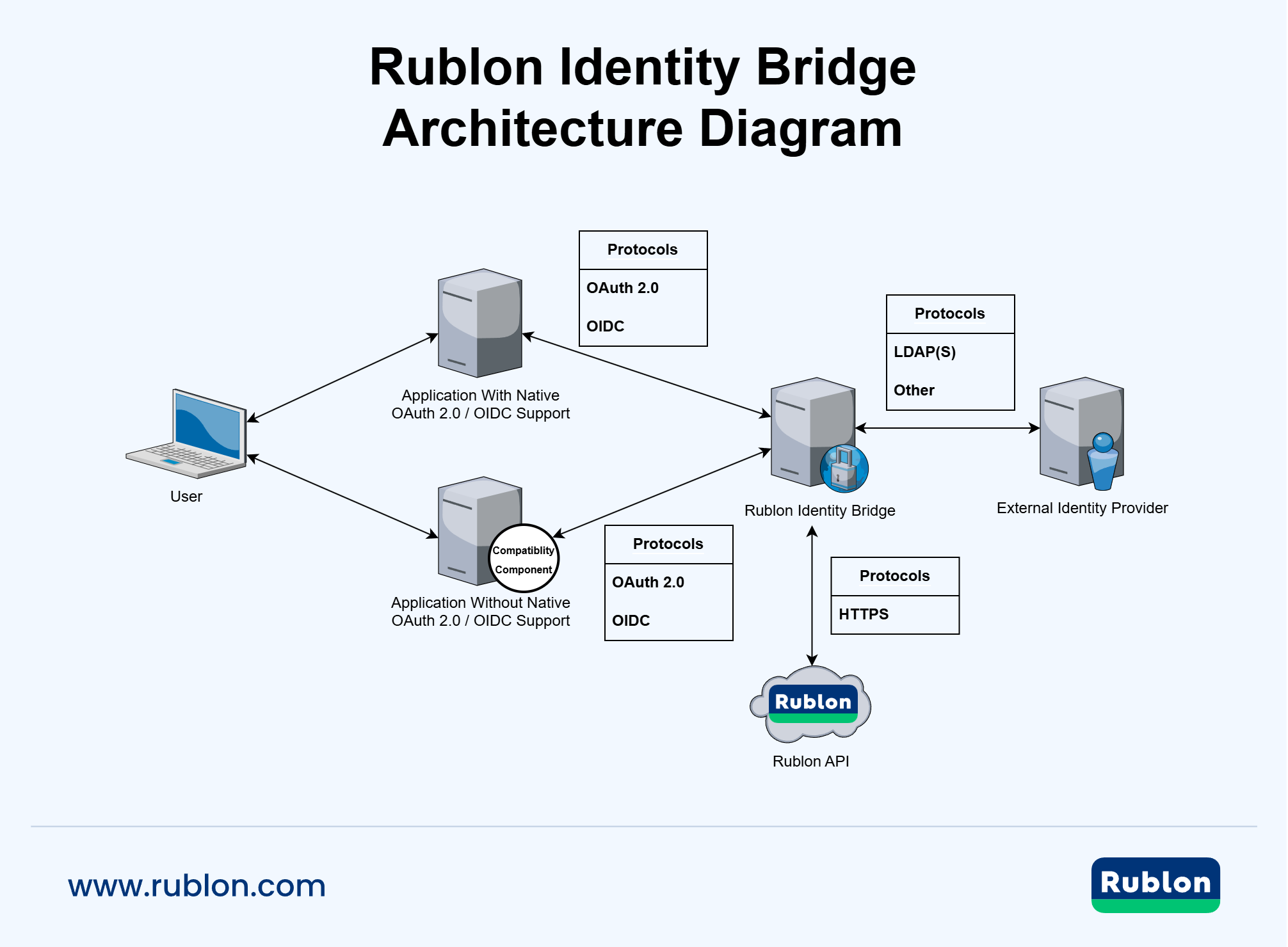
What Is Rublon Identity Bridge?
Rublon Identity Bridge enables Agentless MFA for applications that support OAuth 2.0 or OpenID Connect.
Instead of requiring every application to implement its own MFA flow, organizations configure applications to trust Rublon Identity Bridge for authentication. Rublon Identity Bridge then manages the centralized authentication flow, combining primary authentication with MFA enforcement.
This changes MFA deployment from an application-by-application project into a scalable identity model. Rather than building MFA separately into each system, organizations connect applications to one authorization layer and apply security consistently from there.
Why Agentless MFA Matters
The core advantage of Rublon Identity Bridge is simple: the application does not require its own agent, connector, or plugin for MFA to work.
1. Centralized Protection Without Touching Your Applications
Rublon Identity Bridge shifts authentication from individual systems to a single, unified identity layer. Connected applications benefit from the same strong security model, reducing operational overhead and helping organizations enforce MFA more consistently across the environment.
2. Application Simplicity With Stronger Security
Rublon Identity Bridge removes the need for applications to handle authentication complexity. For OAuth 2.0 and OpenID Connect-compatible applications, identity verification happens in a centralized layer, so the application does not need to implement MFA logic itself.
The application relies on Rublon Identity Bridge as a trusted identity layer instead of requiring its own MFA agent, which reduces deployment effort and helps standardize security across connected applications.
3. More Consistent and Scalable Security
When every application handles authentication differently, security standards drift. Some applications support stronger controls than others. Some require custom work. Some remain outside the MFA perimeter. Rublon Identity Bridge replaces that fragmented model with a centralized one, making it easier to scale MFA across the environment with a more consistent security posture.
How Rublon Identity Bridge Works
Rublon Identity Bridge introduces a centralized identity model between the user and the application.
Applications Connect to the Rublon Authorization Server
Applications that support OAuth 2.0 or OpenID Connect are configured to trust Rublon Identity Bridge as their centralized identity layer.
From the application side, setup is focused on providing the information needed to connect to the Rublon OAuth 2.0 server. This reduces integration effort and avoids application-specific MFA development.
Rublon Identity Bridge Manages Authentication Centrally
For OAuth 2.0 and OpenID Connect-compatible applications, the application itself does not need to implement or manage second-factor logic. Access is granted only after the required authentication steps are completed.
Applications Without Native OAuth 2.0 Support Use a Lightweight Compatibility Layer
For applications that do not natively support OAuth 2.0, Rublon Identity Bridge can be extended with an application-specific compatibility component.
This compatibility component allows selected applications that do not natively support OAuth 2.0 to work with the Rublon Authorization Server, enabling modern login and centralized MFA where native integration is unavailable.
Looking for Agentless MFA for Web Apps?
If your goal is to add Agentless MFA to Web Applications, explore Rublon AppShield.
Agentless MFA for OAuth 2.0 and OpenID Connect Applications
Rublon Identity Bridge supports integration with virtually any application that uses OAuth 2.0 or OpenID Connect, enabling centralized login and MFA through a single standards-based identity layer.
Faster MFA Rollout Without App-By-App Projects
In many environments, the real obstacle to broader MFA adoption is not strategy, but the integration effort. Rublon Identity Bridge removes much of that friction by shifting the work from “build MFA into each app” to “connect the app to the Authorization Server.” That is a much more efficient way to expand MFA coverage.
One Connection Model for Many Applications
Instead of implementing MFA separately in each business application, organizations can connect applications to a single Authorization Server. This creates a unified authentication model that is easier to manage, easier to standardize, and easier to scale.
Better User and Admin Experience
Users benefit from a more consistent sign-in experience across more applications. Administrators benefit from a centralized security model that is easier to govern, document, and maintain.
Extend Modern MFA to Applications Without Native OAuth 2.0 Support
Not every important application supports modern identity standards. Many organizations still rely on applications that were not designed for OAuth 2.0 or OIDC. Rublon Identity Bridge addresses that gap with a lightweight compatibility layer that helps selected applications without native OAuth 2.0 support participate in a modern authentication architecture.
Protect More of the Environment Without Modifying the Application
Replacing or rewriting older systems is expensive and often unrealistic. Rublon Identity Bridge gives organizations another path: extend modern authentication and MFA to selected applications without native OAuth 2.0 support, without requiring full application modernization. That allows security improvements to move forward sooner.
Create One Secure Login Model for Modern and Non-Native OAuth 2.0 Applications
With Rublon Identity Bridge, modern applications can connect directly through OAuth 2.0 or OIDC, while applications without native OAuth 2.0 support can use an optional compatibility layer where needed. The result is a broader, more uniform MFA coverage model across mixed environments.
Business Benefits of Rublon Identity Bridge
Rublon Identity Bridge is not just an identity integration layer. It is a business-ready way to deliver Agentless MFA for OAuth 2.0 and OpenID Connect-compatible applications at scale.
- Reduce Integration Complexity: A single Authorization Server is easier to manage than multiple application-specific authentication approaches. Standardization lowers operational overhead and simplifies future rollouts.
- Strengthen Security Consistently: Because MFA is enforced centrally before access is granted, organizations can apply a more consistent authentication standard across supported applications.
- Accelerate Identity Modernization: Rublon Identity Bridge helps organizations adopt modern identity flows without waiting for every legacy system to be replaced or redesigned.
- Support Cloud, On-Premises, and Hybrid Environments: Organizations rarely operate in a single environment. Rublon Identity Bridge supports a centralized MFA model across distributed application estates.
- Improve Procurement and Architecture Positioning: A centralized, standards-based authentication architecture is easier to describe in technical evaluations, procurement processes, and enterprise security planning than a collection of disconnected application integrations.
Typical Use Cases for Rublon Identity Bridge
OAuth 2.0 and OIDC-Enabled Web Applications
Protect custom web apps and business applications that support standards-based identity integration.
Access Services and Internal Systems Using Modern Identity Flows
Standardize secure login and MFA for services that support token-based authentication through a centralized Authorization Server.
SaaS Platforms With Custom Identity Provider Support
Non-Native OAuth 2.0 Compatibility Layer
A Smarter Way to Deliver Agentless MFA
Rublon Identity Bridge helps organizations close one of the most common gaps in MFA programs: the inability to protect enough applications without adding complexity to every application separately. By enabling Agentless Multi-Factor Authentication for OAuth 2.0 and OpenID Connect-compatible applications through a centralized identity architecture, Rublon Identity Bridge gives security teams a more practical way to expand coverage, standardize login, and move identity modernization forward.
Talk to Us About Rublon Identity Bridge
See how Rublon Identity Bridge can help you deploy Agentless MFA for OAuth 2.0 and OpenID Connect-compatible applications, centralize authentication, and extend modern identity controls across more of your application environment.
Contact us to discuss your environment and deployment goals.