
An administrator needs to sign in during an internet outage. A traveling employee opens a laptop without Wi-Fi. A workstation operates on an internal
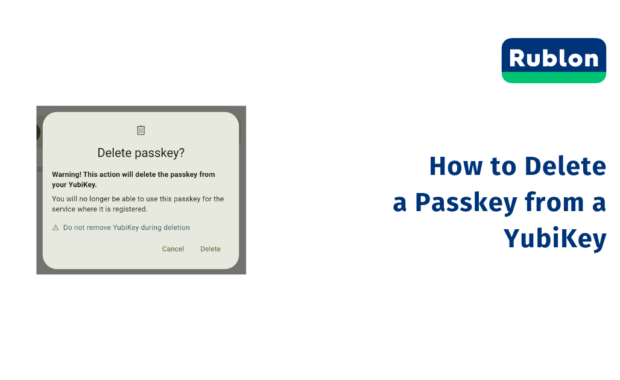
How to Delete a Passkey from a YubiKey: Yubico Authenticator & ykman
Scope: This article covers discoverable FIDO2 credentials, commonly referred to as passkeys, that can be managed on the YubiKey. Non-discoverable
Export MFA Logs to a SIEM for Monitoring and Audit
Multi-factor authentication (MFA) protects access to critical systems, but the value of MFA does not end when an authentication request is approved or
Exporting a Windows Certificate for Rublon Authentication Proxy
When Rublon Authentication Proxy acts as an LDAP Proxy using LDAPS (LDAP over TLS) or STARTTLS (an LDAP connection upgraded to TLS), it must present a

MFA Enrollment via SMS: How to Let Users Self-Enroll Authenticators
Multi-factor authentication (MFA) cannot protect an account until the user has registered at least one authenticator. That simple dependency makes MFA
Real-Time AD Sync: How Real-Time Active Directory Synchronization Works
Active Directory often serves as the source of truth for users, account status, and group memberships. When connected systems rely only on scheduled
Delegated vs. Federated Authentication: What’s the Difference?
Delegated authentication and federated authentication are related concepts, and the terminology is not completely standardized. Federated identity
Enable XRDP and GNOME Logins Using Microsoft Entra ID Credentials and Rublon MFA
Microsoft Entra ID is often an organization’s central identity platform, but Linux desktop environments like Debian cannot normally use Entra ID
Enable SSH Logins Using Microsoft Entra ID Credentials and Rublon MFA
Microsoft Entra ID is often the central identity source for an organization, but Linux servers cannot normally use Entra ID credentials directly for