PIV (Personal Identity Verification) is a U.S. federal identity credential standard (FIPS 201-3) that verifies, issues, and manages secure identity credentials used for physical and logical access to government systems.
Why PIV Matters
- PIV cards support strong authentication, combining cryptography, biometrics, and PINs.
- They bridge physical access (doors) and logical access (computer systems) under one identity framework.
- With derived credentials, PIV is evolving to secure mobile and remote access use cases.
What You’ll Learn
- How PIV works: identity proofing → issuance → authentication → revocation
- The anatomy of a PIV card, cryptographic interfaces, and derived credentials
- Use cases: enterprise, remote access, digital identity, identity verification
- Benefits, risks, security controls, and governance aspects
- Comparisons: PIV vs CAC, alternatives, eligibility, cost, and practical FAQs
- Why PIV Matters
- What You’ll Learn
- Key Takeaways at a Glance
- Core Personal Identity Verification Definitions & Architecture
- PIV Credential Lifecycle & Operation
- Personal Identity Verification Use Cases
- PIV Benefits, Risks & Security Considerations
- PIV vs. Other Credentials & Alternatives
- Personal Identity Verification Implementation & Adoption
- Frequently Asked Questions About PIV
Key Takeaways at a Glance
| Insight | Why It’s Important |
| PIV is more than a smart card | It enforces the federal standard identity trust |
| Cryptography & biometrics are core | They enable strong multi-factor security |
| Derived credentials expand PIV usage | Extends PIV beyond smart cards into mobile and remote |
| Governance & audits are critical | Because PIV handles national identity and high-trust access |
Core Personal Identity Verification Definitions & Architecture
What is a PIV card?
A PIV card (Personal Identity Verification card) is a smart card credential standard used by U.S. federal employees and contractors. It stores cryptographic keys, certificates, biometric data, and a photo, and is used for secure physical and logical access in accordance with the FIPS 201 standard. The PIV card adheres to interface and data formats defined in NIST SP 800-73, ensuring interoperability across agencies.
The PIV card supports contact and contactless interfaces, per FIPS 201 standards.
Stored on the PIV card:
- PIV Authentication certificate and private key for secure identity verification
- Digital signature and encryption credentials to protect sensitive communications
- Biometric templates, such as fingerprint and facial data, for on-card matching
- Cardholder Unique ID (CHUID) and additional structured metadata for system interoperability
What is Personal Identity Verification (PIV)?
Personal Identity Verification refers to the system of verifying and securely issuing interoperable credentials to individuals (employees, contractors) so they can access government facilities, systems, and applications.
The standard is defined in FIPS 201-3, which updates the original FIPS 201 and outlines identity proofing, credentialing, authentication, and card usage.
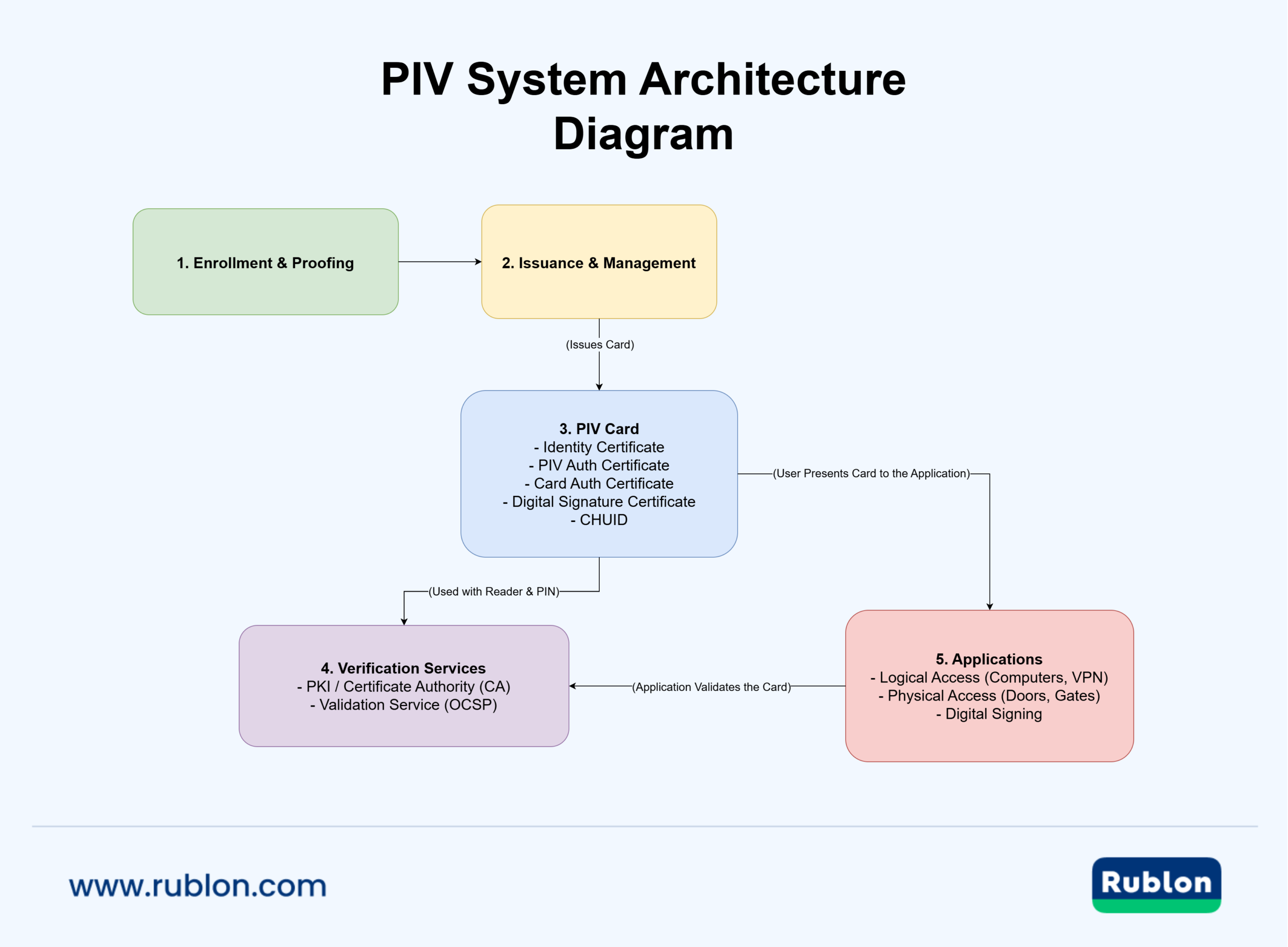
Key Architectural Subsystems
The PIV system consists of three primary subsystems:
| Subsystem | Core Components | Role / Function |
| Front-End Subsystem | PIV card, readers, biometric devices, PIN entry modules | Interface between user and credential; card reads, PIN, biometric matches |
| Issuance & Management Subsystem | Identity proofing systems, credential management, key generation, certificate services, revocation servers | Handles enrollment, issuance, renewal, revocation, and derived credential management |
| Relying Subsystem | Physical/logical access control systems, authorization logic, protected resources | Consumes PIV credentials to grant or deny access |
What Documents and Inputs Are Used to Verify Identity in PIV?
Identity proofing under PIV uses government-approved documents and vetting steps. Typical documents include passports, driver’s licenses, or certified identity documents. The PIV standard mandates multi-factor checks to resist fraud.
Which Identity Verification Methods Are Used in PIV?
PIV employs three authentication factors:
- Something you have — the PIV card (holding keys/certificates)
- Something you know — a PIN to activate the card
- Something you are — biometric data (fingerprint, facial image) stored and matched on the card
These factors support multi-factor authentication in secure environments.
What is PIV authentication?
PIV (Personal Identity Verification) authentication is a secure login method used primarily by U.S. federal employees and contractors. It relies on a government-issued smart card that contains digital credentials and biometric data. When logging in, users authenticate using one or more factors stored on the card, such as a certificate, PIN, or fingerprint, to prove their identity.
Common PIV authentication methods include:
- PKI-based login using digital certificates stored on the card
- Biometric matching (e.g., fingerprint comparison)
- Challenge-response authentication for secure access
- Derived PIV credentials for mobile devices without card readers
PIV Credential Lifecycle & Operation
How Does PIV Work: From Issuance to Use
- An applicant begins the issuance process by undergoing identity proofing and submitting valid identity source documents. Federal agencies follow FIPS 201-3 requirements for proofing, enrollment, and credential generation.
- Once identity is confirmed, the PIV system generates cryptographic keys and issues certificates, personalization (biometric templates, photo), and card issuance.
- After issuance, the credential is activated (PIN setup, biometric enrollment) and ready for day-to-day use (authentication, access).
- Throughout its life, the credential may undergo renewal, suspension, revocation, or replacement as needed. Agencies maintain a registry so status updates propagate in real time.

What Is an Example of Identity Verification?
In the PIV issuance process, a real example would be:
- Presenting a valid passport (photo ID) and a birth certificate (secondary ID)
- Undergoing in-person verification by a credentialing officer
- Having fingerprints and a photograph captured
- Receiving a PIV card with embedded cryptographic and biometric credentials
This is a concrete, real-world identity verification process within the PIV system.
What Happens During Revocation, Suspension & Replacement
- If a PIV credential is lost, stolen, or otherwise misused, it can be suspended or revoked so it can no longer be used for authentication.
- When reissuance is required, the issuing authority may recapture biometrics, reverify identity, and issue a new credential.
- Proper processes must be in place to update the card registry and notify relying systems of the status change in real time.
Which Identity Verification Methods Are Used in PIV Enrollment?
- Identity proofing generally relies on presenting two valid identity documents, at least one of which must be a government-issued photo ID.
- Applicants must usually appear in person for validation and biometric capture. FIPS 201-3 and NIST SP 800-63A require physical identity proofing and biometric capture for high assurance levels (IAL2/IAL3), which applies to PIV.
- In-person appearance is the norm, especially for federal employees and contractors receiving PIV cards. However, supervised remote identity proofing is allowed under specific conditions, using live video and approved procedures. In addition, some agencies pilot remote enrollment in controlled environments, though this is rare and tightly regulated.
- FIPS 201 enforces the separation of duties so that no single individual can complete issuance illicitly.
How Are Certificates & Keys Managed on the Card?
- Once issued, cryptographic keys and certificates are stored securely on the PIV card.
- The card may support contactless / contact communication modes and adhere to SP 800-73 smart card interface standards.
- When a credential expires, renewal may occur automatically or via revalidation, and new certificates are reissued.
Personal Identity Verification Use Cases
1. Identity Verification for Remote Access & Hybrid Environments
- PIV (or derived PIV credentials) supports identity verification for remote access, permitting employees and contractors to authenticate securely when off-site or working from home.
- Derived credentials (issued under FIPS 201-3 & NIST SP 800-157 guidelines) allow a virtual PIV credential on mobile or laptop when a physical card and reader aren’t available.
- Agencies and enterprises often integrate PIV-based authentication with zero-trust architectures and identity federation to unlock remote systems.
- Use example: employees authenticate to VPNs, cloud services, or internal apps using PIV + biometric / PIN in place of passwords.
2. Logical Access & IT Systems
- PIV credentials grant access to protected information systems, internal applications, and networks.
- The same PIV certificate stored on the card can be used for smart card logon, digital signatures, encryption, and network authentication.
- Many organizations configure PIV as a multi-factor authentication (MFA) method for sensitive systems, especially for privileged users. NIST recommends that federal agencies move privileged accounts to PIV-based authentication rather than password-only.
3. Physical Access & Facility Entry
- PIV cards serve as physical access credentials for secure facilities, doors, gates, and controlled zones.
- NIST SP 800-116 provides guidelines on how to use PIV credentials in facility access control systems (PACS) and recommends risk-based selection of PIV authentication mechanisms for physical security.
- The interoperability requirement means a PIV card issued by one federal agency should work in another’s building security systems.
4. Digital Identity & Credential Management
- As organizations adopt digital identity management strategies, PIV becomes a core building block. PIV credentials bind identity, authentication, and authorization in one credential.
- PIV supports secure login with biometrics, encryption, digital signatures, and non-repudiation.
- It intersects with KYC (Know Your Customer) in high-assurance identity environments, especially in regulated sectors that require verifying identity at strong levels.
5. Specialized, Inter-Agency & Federated Use
- PIV-I (Personal Identity Verification – Interoperable) is a variation designed for interoperability with federal infrastructure, but issued by non-federal organizations under less stringent personnel vetting.
- In federated environments, a PIV identity account can assert credentials or identity tokens to enable secure access across agencies and systems. NIST SP 800-217 discusses guidelines for PIV federation and broad digital identity assertions.
- Use case: a contractor uses PIV from their home agency to access partner agency resources or shared systems under trust agreements.
PIV Benefits, Risks & Security Considerations
Why Use a PIV Card? Key Benefits
- Phishing-resistant multi-factor authentication — PIV combines cryptographic credentials, biometrics, and PINs to verify identity with high assurance. Because authentication relies on hardware-backed keys and on-card matching, it resists common phishing, replay, and credential theft attacks.
- Unified credential across domains — One PIV credential can grant both physical and logical access in federal environments.
- Interoperability and standardization — Governed by FIPS 201 and NIST SP standards, PIV ensures cross-agency consistency.
- Support for derived or virtual credentials — Extends PIV use to mobile devices and remote access, reducing reliance on physical card readers.
Looking for a Phishing-Resistant MFA Provider?
Protect your IT infrastrcture from hackers with phishing-resistant multi-factor authentication.
What Are the Key PIV Security Risks & Threats?
1. Loss, Theft, or Misuse of Card
A stolen or lost PIV card can be misused for unauthorized access if additional safeguards (PIN, biometric, certificate checks) are not enforced.
2. Key Compromise & Cryptographic Weaknesses
If the private keys or certificate infrastructure are compromised, attackers could issue or use valid credentials illicitly. All cryptographic aspects must be hardened and tested.
3. Biometric Spoofing / Template Leakage
Because PIV embeds biometric templates, attackers might attempt to spoof fingerprints or facial images or extract template data if the card or system is vulnerable.
4. Revocation & Trust Decay
If revocation mechanisms fail (e.g., CRL/OCSP lag, connectivity failures), revoked credentials may persist in use, exposing systems to unauthorized access.
5. Implementation & Configuration Errors
Misconfiguration, weak PIN policy, non-secure card issuance environments, or poor integration with relying systems can introduce vulnerabilities.
Personal Identity Verification Mitigation & Security Controls
- Card PIN and retry limits – enforce hardened PIN limits, lockouts, and rate limiting.
- Hardware security modules (HSMs) – protect keys used for issuing, signing, and certificate authority operations.
- Secure issuance environments – biometric capture, identity proofing, and card personalization must follow strict process controls.
- Certificate Transparency & auditing – logging and transparency of credential issuance helps detect misissuance.
- Risk mitigation in facility access – NIST SP 800-116 provides guidelines for matching PIV credential strength to facility security levels.
- Monitoring system logs & failed access attempts – agencies like GSA have been critiqued for failing to use access logs to detect risk patterns.
Addressing Common Concerns About PIV
Is PIV ID safe?
Yes, if implemented correctly with layered controls. But safety depends heavily on the operational security, cryptographic robustness, and revocation infrastructure.
How secure are PIV cards?
They are generally considered among the highest standards for identity credentials, but only as secure as the weakest link in the system, e.g., biometric capture, card reader, or certificate trust chain.
Do you have to return your PIV card?
Yes. When someone departs federal employment or their contract ends, their PIV card must be returned or revoked under prescribed procedures.
PIV vs. Other Credentials & Alternatives
What Is the Difference Between PIV vs. CAC?
- The Common Access Card (CAC) is the U.S. Department of Defense’s smart card credential, while PIV is the standard for civilian federal agencies under FIPS 201-3.
- So, CAC is for the military (DoD), while PIV is the standard for civilian federal agencies.
- CAC and PIV share many technical traits (smart chip, PKI certificates, PIN, biometric support), but use different issuing authorities and root certificate ecosystems.
- In practice, federal systems often accept both PIV and CAC for authentication, depending on integration support.
What Is the Alternative to the PIV Card?
- Multi-factor authentication systems without a card (e.g., hardware tokens, FIDO2 passkeys, FIDO2 & FIDO U2F security keys, authentication apps)
- Derived credentials / virtual PIV (mobile or certificate-based without a physical card)
- Other smart card / credential systems (e.g., agency-specific card programs)
- In non-federal or private enterprise contexts, digital identity systems may rely on identity proofing + biometric + device credentials rather than full PIV infrastructure
Can Free / Open / Non-Federal Credentials Be Used Instead of PIV?
- PIV-I (Personal Identity Verification – Interoperable) credentials are intended to interoperate with federal PIV infrastructure, even for non-federal issuers. Not fully identical to PIV, but may serve as a practical alternative for guest or contractor access.
- However, PIV-I does not assert full personnel vetting assurance. Agencies may choose whether or not to accept PIV-I credentials.
Personal Identity Verification Implementation & Adoption
Who Is Eligible for a PIV Card?
Not everyone can automatically get a PIV credential. Typical eligibility criteria include:
- Federal employees and contractors needing access to systems or facilities for six months or more under FIPS 201 / HSPD-12 policy.
- Completion of a background investigation or vetting process (e.g., Tier 1, NACI, SAC). For example, VA requires the successful adjudication of the required check before issuing a PIV card.
- A sponsoring authority (HR, security office) submits the request and ensures identity proofing.
- If full eligibility is not met, applicants may be issued a PIV-I credential (interoperable but with reduced vetting).
How to Request a Personal Identity Verification (PIV) Card
- An applicant works with their PIV sponsor (often HR or security office) to initiate the request.
- The applicant visits a credentialing center / badging office, presenting two valid identity documents and completing identity proofing.
- Biometric data (photo, fingerprints) are captured, and keys and certificates are issued.
- The card is then activated (PIN setup, enrollment) and delivered.
- Agencies typically follow the USAccess issuance system and shared credentialing services.
What Does a PIV Card Cost?
According to GSA’s current rates:
- Enrollment and identity proofing: ≈ USD 23
- Printing & issuance: ≈ USD 30 (covers certificate loading and card printing)
- Ongoing maintenance: ≈ USD 3.95 per card per month after the initial period
- Agencies may also incur costs for credential centers, printer leases, and setup costs.
Mandates, Standards & Policy Drivers
- PIV is mandated by HSPD-12 and defined in FIPS 201-3, which governs both identity proofing and credential interoperability.
- Agencies must comply with OPM credentialing standards procedures, including eligibility adjudication, suspension, revocation, and appeals.
- Newer guidance encourages the adoption of federated PIV identity and interoperability via NIST SP 800-217 to allow PIV identity accounts to be used in federated contexts.
PIV Adoption Challenges & Best Practices
- Legacy system integration: Many existing access control systems may not support PIV; integration often requires middleware, PKI bridging, or system upgrades.
- User training & onboarding: Rolling out PIV across large populations demands awareness, logistical coordination, and user support.
- Credential management and scale: Handling renewals, lost/stolen cards, revocation, and derived credential issuance requires robust infrastructure.
- Interoperability coordination: Ensuring PIV issued by one agency or vendor works across others; adherence to FIPS and approved product lists helps.
- Cost allocation: Agencies must budget for issuance, printing, maintenance, center operations, and replacement cycles.
Frequently Asked Questions About PIV
Can anyone get a PIV card?
No. Because PIV is governed by strict eligibility rules. Applicants must be federal personnel or contractors meeting specific access criteria. The PIV issuance process also includes background investigation and identity proofing.
Do all federal employees get a PIV card?
No. PIV eligibility is generally limited to federal employees and contractors requiring access to federal facilities or systems for six months or more. Individuals without a qualifying role or access requirement may not be issued a PIV credential.
Does TSA accept a PIV card?
Yes. The PIV card is listed among the acceptable forms of identification at U.S. airport security checkpoints under TSA rules. However, in practice, some TSA agents or scanning machines may not consistently recognize the card, which can lead to occasional requests for an alternative ID.
Do PIV cards work as a Real ID?
PIV cards (HSPD-12 credentials) are accepted as valid IDs under TSA’s acceptable ID list, and are considered an alternative to state-issued Real ID cards at airports. That said, the PIV is not a state Real ID license, but functions as a federally accepted credential for identity verification in many contexts.
What documents can be used to verify identity for PIV issuance?
During the identity proofing stage, an applicant must present two original identity source documents, one of which must be a government-issued photo ID. The other may include a birth certificate, a Social Security card, or a similar official document. If names differ on the documents, official name-change evidence (e.g., marriage certificate) must also be provided.