
Challenge-response authentication is a security protocol in which one party (the verifier) issues a random challenge, and the other party (the claimant) must compute and return a valid response, proving its identity without ever sending a static secret.
This mechanism ensures that credentials (like passwords or keys) are never exposed directly over the network, protecting against replay attacks and eavesdropping. Because each challenge is fresh and unpredictable, even if an attacker intercepts a response, it cannot be reused in another session. This is the foundational difference from simple password exchange systems.
- Core Components of the Protocol
- Challenge-Response Authentication: Key Takeaways
- How Does Challenge-Response Authentication Work?
- Protocols & Variants of Challenge-Response Authentication
- Strengths and Weaknesses of Challenge-Response Authentication
- Security Enhancements & Best Practices for Challenge-Response Schemes
- Real-World Use Cases for Challenge-Response Authentication
- Implementation Considerations & Performance
- Future Trends & Emerging Directions in Challenge-Response Authentication
- Conclusion
- Challenge-Response FAQ
Core Components of the Protocol
| Component | Description |
| Challenge | A random nonce or value generated by the verifier |
| Response | A computed value based on the challenge and a secret |
| Secret | A shared secret, password, or cryptographic key used to derive the response |
| Verifier | The system or server validating the response |
| Claimant | The entity (user, device, or smart card) proving identity |
Challenge-Response Authentication: Key Takeaways
- Mitigates Replay Attacks – The use of nonces or fresh challenges prevents attackers from reusing old responses.
- Protects Secrets from Exposure – The secret is never transmitted, reducing the risk of interception and leakage.
- Enables Mutual Authentication – In more advanced setups, both client and server can issue challenges to each other to verify both sides.
- Supports Diverse Authentication Schemes – Challenge-response authentication underlies many protocols, from smart card authentication to one-time password systems.
Table: Password-Only vs. Challenge-Response Authentication
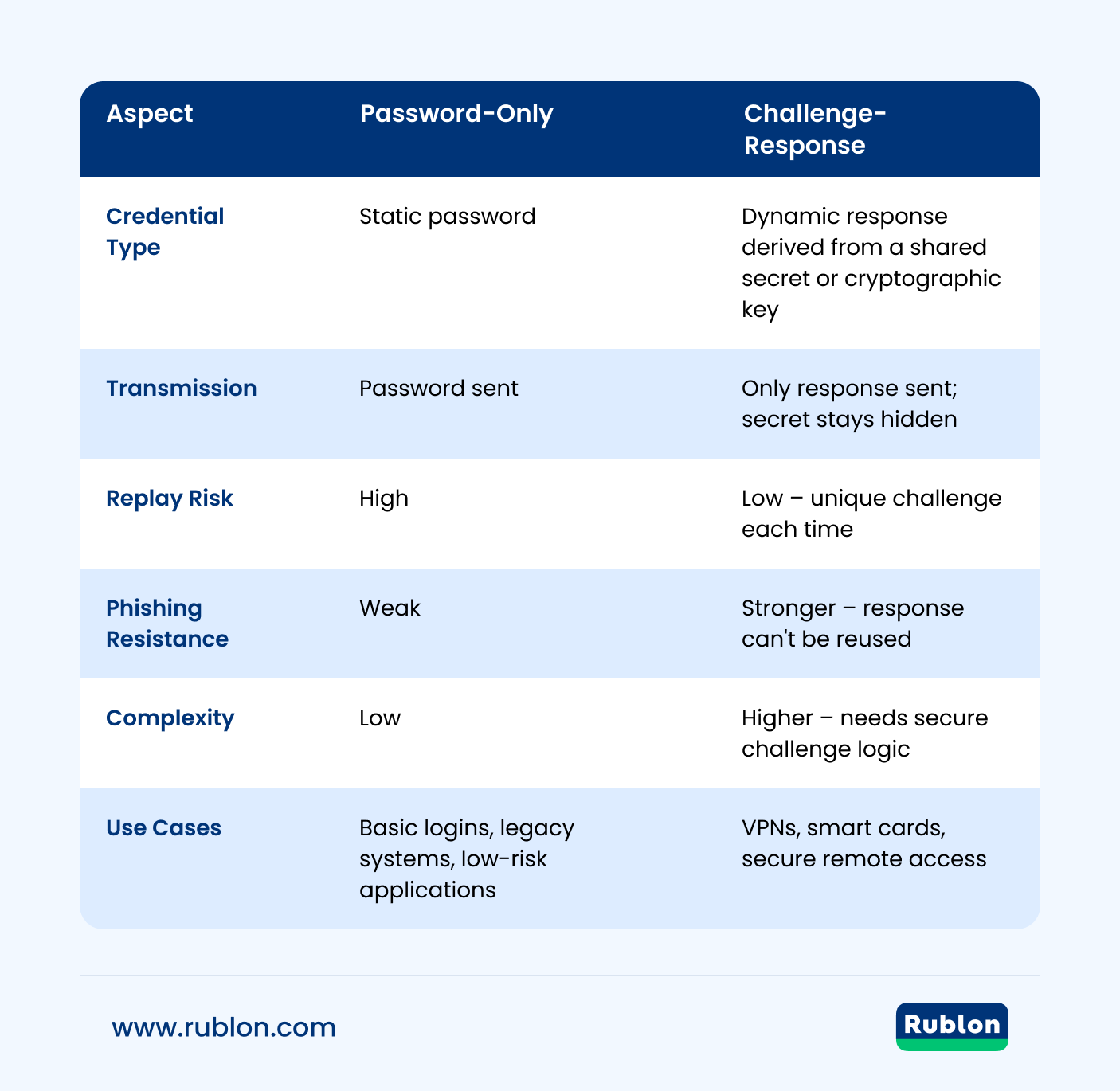
| Aspect | Password-Only | Challenge-Response |
| Credential Type | Static password | Dynamic response from secret/key |
| Transmission | Password sent | Only response sent; secret stays hidden |
| Replay Risk | High | Low – unique challenge each time |
| Phishing Resistance | Weak | Strong – response can’t be reused |
| Complexity | Low | Higher – needs secure challenge logic |
| Use Cases | Basic logins, legacy systems, low-risk applications | VPNs, smart cards, secure remote access |
How Does Challenge-Response Authentication Work?
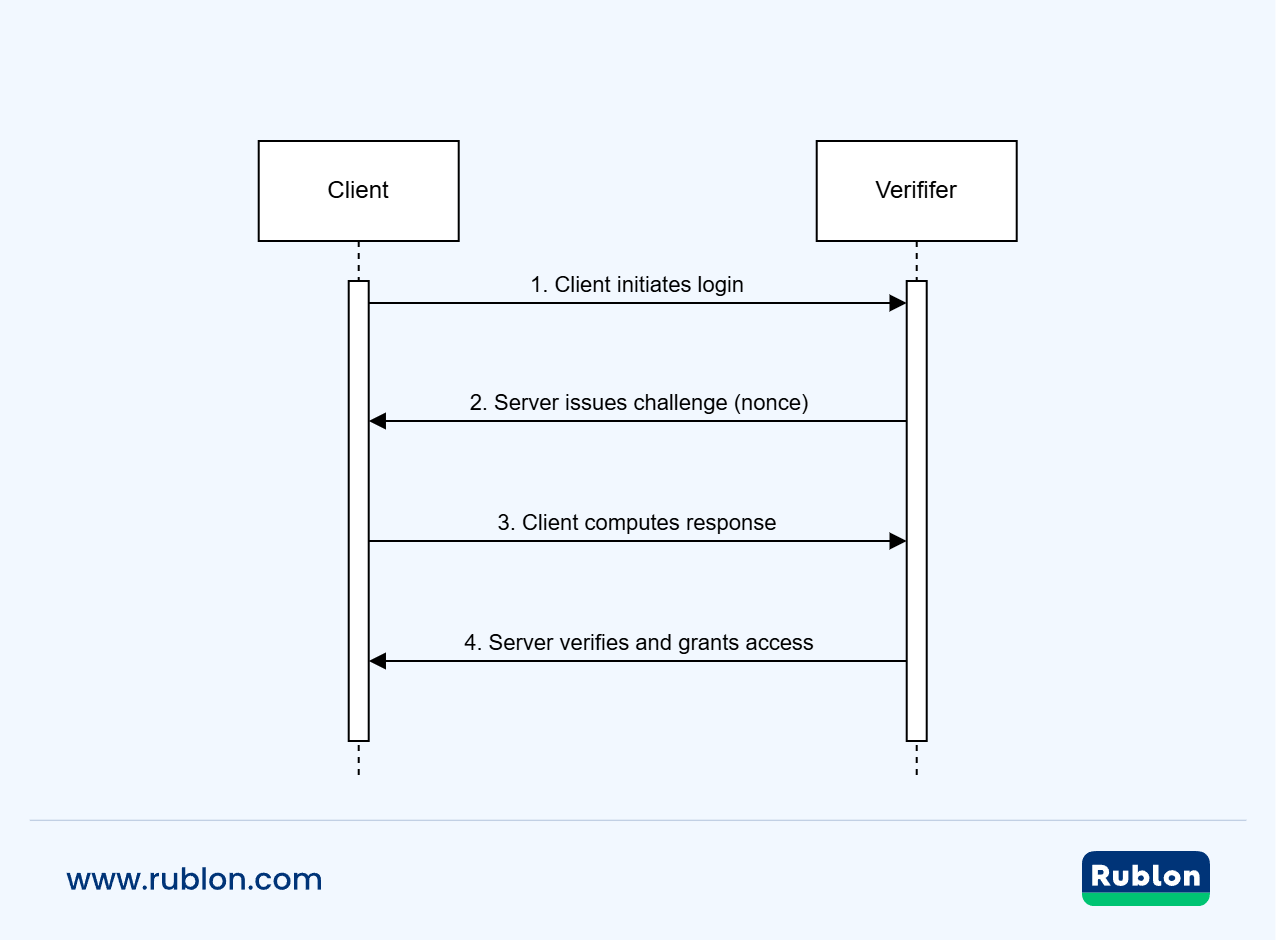
Challenge-response authentication works by having one party (the verifier) issue a fresh “challenge” (often a random nonce), and the other party (the claimant) compute and return a “response” derived from that challenge plus a secret known only to them. If the response matches expectations, the claimant is authenticated.
Below is a step-by-step procedure, followed by variants and reflections on mutual authentication.
Standard Workflow
- Verifier Generates Challenge
- The verifier (server, host, or authentication module) produces a random value (nonce).
- The challenge must be unpredictable and unique per session to prevent reuse.
- Verifier Sends Challenge to Claimant
- The challenge is transmitted to the client, user agent, or device that seeks to prove identity.
- Claimant Computes Response
- The claimant uses a cryptographic function (typically an HMAC or another keyed function) that combines the challenge with a shared secret to compute the response.
- The result is the response value.
- Claimant Sends Response
- The response (often along with an identifier) is returned to the verifier.
- Verifier Validates Response
- The verifier performs the same computation internally (challenge + secret) and compares its expected response to the claimant’s submission.
- If they match, authenticate; otherwise, reject.
- (Optional) Derive Session Keys or Continue Protocol
- Sometimes the exchange also leads to establishing a session key or further encryption for communication.
Because the secret is never transmitted, an eavesdropper cannot obtain it by observing the exchange. Additionally, because every challenge is fresh, a response captured in one session is useless in another.
Variant: Mutual Challenge / Two-Way Authentication
In more secure systems, both parties play the role of challenger and responder:
- The server issues a challenge to the client, and the client issues a challenge to the server.
- Each side verifies the other’s response.
- This guards against rogue servers and man-in-the-middle attacks.
However, care must be taken: naive symmetric challenge responses can be vulnerable to reflection attacks. A reflection attack occurs when an attacker relays the verifier’s challenge back to the verifier itself, tricking it into authenticating the attacker.
How Challenge-Response Authentication Prevents Replay and Eavesdropping
- Freshness guarantee: Every session uses a new challenge, so a recorded response from a prior session cannot be replayed.
- Secret protection: The secret is never transmitted; only the derived response is sent.
- Computational binding: Only someone with the correct secret can compute the correct response.
- Optional server verification: When using mutual challenge, the client also ensures the server is legitimate.
Protocols & Variants of Challenge-Response Authentication
Challenge-response authentication is not a single protocol but a family of methods. Below are key variants and implementations, showing how different protocols handle the challenge-response pattern in real systems, helping you understand the challenge-response authentication protocol in practice.
CRAM-MD5: A Classic SASL Mechanism
CRAM-MD5 (Challenge-Response Authentication Mechanism using MD5), described in RFC 2195, is one of the older and simpler challenge-response schemes.
How It Works
- The server sends a base64-encoded random challenge.
- The client decodes the challenge, computes HMAC-MD5(challenge, secret) (using the shared secret).
- The client prefixes the result with the username and sends it (often base64-encoded).
- The server replicates the same HMAC computation and compares it with the client’s response; if they match, authentication succeeds.
Advantages
- Avoids sending the password in clear text over the network.
- Simple implementation and widely supported in older systems and SASL stacks.
Limitations & Weaknesses
- Lacks mutual authentication, so the client does not verify the server.
- Susceptible to offline dictionary or brute force attacks if an attacker captures a valid response.
- The server often must store plaintext passwords to compute the response, which is a security liability.
- Because MD5 and HMAC-MD5 are aging, CRAM-MD5 is considered deprecated.
SCRAM: Salted Challenge Response Authentication Mechanism
SCRAM, described in RFC 5802, is a more modern, password-based challenge-response protocol designed to mitigate many of the weaknesses of older schemes like CRAM-MD5.
How It Works (High Level)
- The server and client use salts and iteration counts (e.g., PBKDF2) to derive a “salted password” from the user’s password.
- The protocol is interactive and involves the exchange of client nonce, server nonce, proofs, and signatures across multiple messages.
- The server also sends its own proof (signature) so the client can verify the server (mutual authentication).
Advantages & Features
- Stronger resistance to offline dictionary attacks because the server stores salted, iterated hashes rather than raw passwords.
- Mutual authentication capability helps guard against rogue servers.
- Channel binding (linking the authentication to the transport layer, e.g., TLS) enhances security.
- Widely adopted in protocols and systems (e.g., MongoDB uses SCRAM by default).
Considerations & Complexity
- More complex to implement due to multiple message exchanges, nonce management, and cryptographic steps.
- Requires careful choice of iteration counts, salt lengths, and cryptographic primitives.
- If channel binding is not used, some of the extra protection is lost.
NTLM: Microsoft’s Challenge-Response Protocol
NTLM is a proprietary challenge-response authentication protocol developed by Microsoft, used in Windows environments.
- The server sends an 8-byte challenge.
- The client uses a password hash (e.g., NT hash) to encrypt or compute a response.
- The response is validated by the server or domain controller.
- Variants (NTLMv2) strengthen resistance to replay and enhance security.
NTLM is often combined with Kerberos or used as a fallback in Windows domains. Though still present in legacy systems, NTLM has notable vulnerabilities, such as “pass-the-hash” attacks, discussed further in NTLM vs. Kerberos.
Comparing Protocols: Which One to Use?
For new systems, SCRAM is the preferred choice due to its balance of security and deployability. CRAM-MD5 is largely historic, and NTLM remains for compatibility in certain Microsoft environments, but should be phased out where possible.
| Protocol | Mutual Authentication | Offline Attack Resistance | Server Storage Requirement | Modern Usage |
| CRAM-MD5 | No | Moderate | Plaintext or reversible | Legacy, deprecated |
| SCRAM | Yes | High | Salted hash | Recommended for new deployments |
| NTLM | Partial (in newer versions) | Weak | Hashes | Legacy Microsoft environments |
Strengths and Weaknesses of Challenge-Response Authentication
Challenge-response authentication combines several potent security features, but it is not without its trade-offs. In this section, we examine both the advantages and the weaknesses to give you a balanced, practical view.
Strengths of Challenge-Response Authentication
- Secrets Are Never Transmitted: Because the client only sends a computed response (derived from the challenge and secret), the actual secret (password or key) is never exposed over the network. This reduces the risk of interception by eavesdroppers.
- Replay Attack Resistance: A fresh challenge (nonce) in each session ensures that a captured response from a prior session cannot be reused successfully.
- Flexibility for Mutual Authentication: Some challenge-response schemes support bidirectional challenge and verification, allowing the client to authenticate the server too. This helps mitigate certain man-in-the-middle (MITM) risks.
- Support for Session Key Derivation: After successful authentication, systems often derive a session key from the challenge/response exchange. This avoids requiring a separate key exchange.
- Compatibility with Varied Protocols: It is foundational in many protocols (SMTP, IMAP, LDAP, SASL) and systems, especially when password reuse must be avoided. For example, SCRAM (Salted Challenge Response Authentication Mechanism) is widely used in Internet services.
- Improved Resistance to Database Breach: In modern designs (e.g., SCRAM), the server stores only salted and iteratively derived keys instead of plaintext passwords. This approach helps minimize the impact if an authentication database is compromised.
Weaknesses, Risks, and Limitations
- Vulnerability to Offline Dictionary & Bruteforce Attacks: If an adversary captures a valid response and also knows (or guesses) the challenge and algorithm, they may attempt to brute-force the secret offline. This is particularly dangerous if the secret is weak or poorly chosen.
- Lack of Mutual Authentication in Many Schemes: Older protocols like CRAM-MD5 do not require the client to verify the server. As a result, a malicious server could pose as the legitimate one.
- Reflection Attacks in Symmetric Challenge Models: Attackers can sometimes replay a challenge back to the originator to trick it into authenticating the attacker. Proper protocol design must guard against this.
- Server Storage Requirements & Liability: Some legacy schemes require the server to store plaintext passwords or reversible secrets so it can compute responses. This increases security risk in the event of a server breach.
- Computational & Performance Overhead: Stronger variants (e.g., SCRAM) use salting and multiple iterations of hashing, which impose CPU cost on both client and server. On constrained devices, this may hurt latency.
- Dependency on Secure Channel for Full Protection: Even with challenge-response, many protocols recommend or require transport security (TLS) to guard against traffic interception, hijacking, or downgrade attacks.
- Client Side Burden & Usability: In mutual or heavy challenge models, the client may have to do more cryptographic work, which can tax low-power devices.
So… “Is Challenge-Response Secure?” — Quick Answer
Yes, challenge-response authentication can be very secure if it follows best practices: use strong secrets, unpredictable nonces, mutual authentication where needed, and combine with transport encryption. Security is further enhanced when paired with multi-factor authentication (MFA), which adds an extra layer of defense against impersonation and replay attacks.
Security Enhancements & Best Practices for Challenge-Response Schemes
Challenge-response authentication schemes are most secure when paired with robust enhancements and sound design decisions. Below are key practices that harden implementations, reduce vulnerabilities, and help answer whether challenge-response is secure in real-world settings.
Use Strong, Random Nonces
- Always generate the challenge (nonce) using a cryptographically secure random source.
- Ensure nonces are long enough (e.g., 128 bits or more) to avoid collisions or predictability.
- Do not reuse a challenge across sessions. Freshness is essential to prevent replay attacks.
Employ Salts & Work Factors
- In modern schemes like SCRAM (Salted Challenge Response Authentication Mechanism), the server stores a salt and iteration count to derive a “salted password” instead of storing plaintext secrets.
- The use of key derivation functions (e.g., PBKDF2, Argon2) with iterations slows down brute force attempts.
- Even if the authentication database is compromised, attackers cannot immediately compute passwords.
Layering MFA (Multi-Factor Authentication)
- Multi-Factor Authentication (MFA) means combining independent factors (something you know, something you have, something you are).
- A challenge-response exchange can serve as one factor (knowledge or possession), paired with a second factor like an OTP, biometric scan, or hardware token. For example, you can use challenge-response to verify knowledge of a secret and then prompt for a one-time passcode (OTP) or biometric confirmation
- Advanced systems like Rublon MFA can be integrated with challenge-response authentication systems via RADIUS and LDAP protocols. When a user authenticates via RADIUS (which uses challenge-response), Rublon MFA can intercept the request and enforce multi-factor login before granting access. This ensures that even if the primary credentials are compromised, access is blocked without the second factor.
- In addition, systems like OpenVPN support configuring challenge-response as part of MFA workflows (e.g., certificate + challenge/response + OTP) to strengthen security.
Sign up for a Free Rublon MFA Trial →
Use Mutual Authentication and Channel Binding
- Where possible, implement mutual challenge so that the client also verifies the server, protecting against rogue servers and man-in-the-middle.
- Combine with channel binding to bind the authentication to the underlying TLS session, ensuring a single coherent trust channel. SCRAM supports channel binding extensions (e.g., “PLUS” variants) when used over TLS.
- Proper channel binding helps forestall downgrade attacks.
Enforce Freshness and Timeouts
- Set short time windows for accepted responses (e.g., challenge expiry of a few seconds or minutes).
- Reject responses after the expiry period to protect against delayed replay attempts.
Avoid Weak Secrets & Enforce Complexity
- Enforce password complexity, length, and entropy to reduce susceptibility to guessing or dictionary attacks.
- Use rate limiting or throttling on authentication attempts to slow brute force.
- Prefer secrets derived from higher-entropy sources (random keys, hardware tokens) in high-sensitivity systems.
Secure Server Storage and Key Handling
- Servers should never store plaintext secrets. Instead, they should retain only salted and derived keys (as in SCRAM) or hashed credentials.
- Protect the authentication store using encryption and limited access.
- Regularly rotate or refresh salts/keys as needed.
Use Secure Cryptographic Primitives
- Prefer modern and secure hash functions (e.g., SHA-256, SHA-512) over deprecated ones (e.g., MD5).
- Use vetted HMAC or keyed-hash constructs rather than home-rolled or weak combinations.
- When integrating with libraries, rely on standardized, audited modules.
Logging, Monitoring, and Fail Safes
- Log authentication failures and abnormal error rates to detect attack patterns.
- Implement lockouts or temporary bans after repeated failed challenge attempts.
- Monitor for suspicious behaviors (e.g., repeated invalid responses, abnormal latency) as an early warning of exploitation attempts.
Combine With Transport Security (TLS / SSL)
- Always run challenge-response exchanges over a secure channel (e.g., TLS) to protect against eavesdropping, downgrade, or man-in-the-middle (MITM) tactics.
- Even though the secret isn’t transmitted, metadata, identifiers, or timing side channels can be attacked without encryption.
- Use certificate pinning or strict TLS validation to strengthen end-to-end trust.

Real-World Use Cases for Challenge-Response Authentication
Challenge-response authentication plays a vital role in today’s security landscape, powering everything from VPNs to enterprise login systems. Here are common scenarios illustrating how challenge-response authentication is deployed in the real world, and why it remains useful alongside modern alternatives.
Email and Mail-Server Authentication (SMTP, IMAP, POP3)
- CRAM-MD5 in Email Protocols: One of the classic use cases is CRAM-MD5 in SMTP, IMAP, and POP3 authentication. Because these protocols often operated over unencrypted channels historically, using CRAM-MD5 prevented passwords from being sent in clear text. However, CRAM-MD5 is now considered outdated and insecure, so many deployments require TLS (STARTTLS) or migrate toward SCRAM or OAuth mechanisms.
- SCRAM in Modern Email / Messaging Systems: SCRAM (Salted Challenge Response Authentication Mechanism) is used more recently in systems like XMPP, LDAP, and email services to provide stronger, salted response schemes.
Banking, Online Services & MFA
- Challenge via Out-of-Band Channels: Banks and financial services often send challenges via SMS, email, or app push, requiring the user to respond (e.g., entering a code). This is a form of challenge-response authentication layered over another authentication factor.
- Token / Hardware Devices in Enterprise Systems: Enterprise token systems (hardware or software) sometimes support challenge-response mode.
Network Access & Remote Authentication (VPN, RADIUS, 802.1X)
- VPN and RADIUS Authentication: Many VPN solutions and RADIUS servers support challenge-response or challenge-response + OTP modes. The server issues a challenge, and the client responds using a shared secret or token-derived value.
- 802.1X / EAP Methods: Some EAP (Extensible Authentication Protocol) methods use challenge-response under the hood (e.g., EAP-MD5, though EAP-MD5 is weak). Modern EAP methods that incorporate more robust cryptographic exchanges may embed challenge-response mechanisms.
Access Control Devices & Embedded Systems
- Physical Access Control / Smart Cards: In access control systems (smart card readers, badge systems), the system can issue a challenge to the card or device, which then computes a response using its secure key. This prevents replay and cloning attacks.
- Internet of Things (IoT) & Embedded Devices: Constrained IoT devices often cannot adopt full-blown asymmetric crypto, so lightweight challenge-response mechanisms may be used to authenticate devices securely with minimal overhead.
One-Time Password & OATH Methods (HOTP / OCRA)
- HOTP as a Challenge-Response System: Although HOTP (HMAC-based One-Time Password) is not a classical challenge-response system, it is sometimes seen as one. The server sends a challenge or counter, and the client responds with an OTP computed from it.
- OCRA: OATH Challenge-Response Algorithm: The OATH standard defines a challenge-response OTP mechanism (OCRA) where a challenge (numeric string) is input into the OTP algorithm with a secret to yield a response. This is common in banking token systems.
Implementation Considerations & Performance
Challenge-response authentication brings security, but real systems must balance robustness with performance, scalability, and practicality. This section explores key trade-offs, pitfalls, and strategies, helping you answer challenge-response-based authentication system design questions with confidence.
Cryptographic Load & Latency
- Each authentication requires cryptographic computation (hash, HMAC, key derivation), which adds time. In resource-constrained environments (mobile devices, IoT), this latency may matter.
- Research in wireless networks shows that challenge/response adds measurable delays and signaling overhead, especially when scaled or repeated.
- Use efficient primitives (e.g., SHA-256, HMAC) and tune iteration counts for acceptable trade-offs between security and responsiveness.
Scalability Under Load
- In high-traffic systems (large web apps, API backends), authentication is a hot path. Even slight delays per request multiply across hundreds or thousands of concurrent users.
- Employ caching strategies carefully (e.g., caching derived secrets or intermediate values) while avoiding security compromises.
- Use load balancing, distributed authentication servers, or batching where feasible.
Network Overhead & Message Exchanges
- Some protocols require multiple message round-trips (e.g., SCRAM), increasing network latency and susceptibility to timeouts.
- In high-latency networks (mobile, satellite links), minimize protocol chattiness or collapse exchange steps if secure.
- Combine or piggyback challenge/response in existing handshake messages where protocol design allows.
Usability & Client Constraints
- Challenge-response should impose minimal friction on users. Long delays or complex steps harm adoption.
- On constrained clients (low CPU, limited memory), balance cryptographic work with battery/memory considerations.
- If part of a multi-factor authentication solution, gracefully degrade or fallback for weaker devices.
Handling Failures & Edge Cases
- Account for dropped or timed-out messages: implement retries, but avoid replay vulnerabilities.
- Gracefully degrade or fall back to other authentication methods where challenge-response fails (e.g., fallback to OTP).
- Log and detect abnormal rates of failures (possible brute force or denial-of-service).
Security Pitfalls & Attack Vectors
- Reflection Attacks: If the same protocol is used in both directions and not carefully designed, an attacker can reflect challenges to force authentication.
- Off-Path Attacks & Illusion of Security: Some systems rely on “unpredictable header fields” as challenges (e.g., DNS, TCP). Experimental work shows that off-path attackers can sometimes exploit predictability to bypass challenge-response protections.
- Pass-the-Hash in NTLM: In Microsoft challenge-response (NTLM), attackers can reuse captured hash responses to impersonate users, especially if the hash remains static.
Optimization & Best Practices for Implementers
- Use parameter tuning: choose iteration counts, salt lengths, and cryptographic primitives that balance security and speed.
- Precompute or cache reusable intermediate components when secure (for example, caching KDF outputs) to reduce per-authentication cost.
- Monitor performance and latency so cryptographic costs can be adjusted over time.
- Use profiling to find hotspots (e.g., hash operations, network I/O) and optimize accordingly.
- Enable graceful scaling: e.g., autoscaling authentication servers, distributing load, and backing off under saturation.
Future Trends & Emerging Directions in Challenge-Response Authentication
Challenge-response authentication continues evolving. Here are key trends, protocol enhancements, and areas to watch.
Adaptive & Contextual Challenge Schemes
- Modern systems increasingly use adaptive challenges that vary in difficulty or type depending on user risk signals (device, location, behavior).
- For example, a first login from a trusted device might use a lightweight challenge, while suspicious access triggers a stronger or multi-factor challenge.
- This helps balance usability and security dynamically, aligning with zero-trust principles.
Protocol Evolution: SCRAM Enhancements & HTTP SCRAM
- The SCRAM family of protocols is evolving. A new draft SCRAM-bis refines channel binding, algorithm agility, and modern cryptographic defaults.
- HTTP SCRAM (RFC 7804) adapts SCRAM for the HTTP realm, enabling salted challenge-response authentication for web APIs and browser clients.
- These protocols reflect a shift away from older challenge-response methods and toward more secure, standardized, deployable variants.
Standardized Token / OATH Challenge-Response (OCRA)
- OCRA (OATH Challenge-Response Algorithm) is an open standard that generalizes challenge-response for OTP and transaction authentication.
- OCRA allows for challenge parameters, counters, or user input to influence responses. It is used in banking and hardware token systems.
- Because it’s vendor-agnostic, OCRA helps reduce lock-in and supports interoperable tokens.
Hybrid & Zero-Knowledge Proof Protocols
- Emerging protocols combine challenge-response with zero-knowledge proofs (e.g., OPAQUE, TLS-SRP) to allow authentication without revealing secrets, enhancing privacy.
- These hybrid proofs may also support multi-factor attributes (e.g., biometrics, device keys) within a single proof.
- As privacy regulations tighten, this direction is gaining increased attention in research and industry.
Wider Adoption in IoT and Trustless Environments
- As Internet of Things (IoT) devices proliferate in constrained environments, lightweight challenge-response techniques adapted for low power/low bandwidth are crucial.
- Some proposals embed challenge-response into attestation and remote verification frameworks (e.g., TPM attestation described in RFC 9683).
- Challenge-response may serve as one leg in multi-protocol trust stacks (e.g., combined with attestations, secure boot, and device identity verification).
Threats From Advanced Attack Techniques
- Off-path attacks challenge the assumption that challenge fields or unpredictable header values are secure. Research shows adversaries bypassing challenge-response protections via side channels or injection.
- Attackers may exploit weaknesses in randomness sources, reuse, or protocol logic to reduce security.
- Future systems need to guard against such sophisticated threats, possibly combining challenge-response with cryptographic protections (TLS, DNSSEC, etc.).
Conclusion
Challenge-response authentication is a foundational technique in cybersecurity. It lets one party prove knowledge of a secret without ever sending that secret across the wire. Over decades, it has powered email protocols, network access, hardware tokens, and cryptographic systems. Yet its true strength lies not in the idea itself, but in how it is implemented.
Challenge-Response FAQ
What does challenge-response mean?
Challenge-response means an authentication method where a verifier sends a fresh, unpredictable challenge (typically a random nonce) and the claimant proves identity by returning a computed response derived from that challenge plus a secret (a password-derived key, shared key, or private key), so the secret itself is never transmitted; because each challenge is unique per session, a captured response generally cannot be reused, which is the key reason challenge-response is used to reduce replay risk compared to static password exchange.
What is the challenge-response process?
In a typical challenge-response process, the verifier generates a unique challenge and sends it to the client, the client computes a response using a cryptographic function that binds the challenge to a secret it possesses, the client returns the response (often with an identifier), and the verifier validates it by recomputing the expected value (shared-secret designs) or verifying a signature (public-key designs) while also enforcing freshness (timeouts and single-use nonces) so that old responses cannot be replayed.
What is the challenge-response procedure?
The challenge-response procedure is the operational step-by-step execution of challenge generation, transmission, response computation, and validation, and a secure implementation additionally requires strong randomness for the challenge, strict freshness controls (short expiry and replay prevention), rate limiting for failed attempts, secure secret storage (e.g., salted verifiers rather than plaintext passwords in password-based schemes), and often transport security such as TLS to protect metadata and reduce interception and downgrade risks.
What is challenge-response authentication?
Challenge-response authentication is a protocol family in which the system authenticates a user or device by testing whether it can correctly answer a one-time cryptographic challenge using a secret it holds, which strengthens security by avoiding transmission of a static secret and by tying each authentication attempt to a unique challenge; depending on the variant, it can also support mutual authentication (client verifies server too), but it still requires careful design to avoid pitfalls like offline guessing attacks or weak server-side secret handling.
What is an example of a challenge-response?
A straightforward example is HMAC-based challenge-response where the server sends a random nonce and the client returns HMAC(secret, nonce), allowing the server to compute the same HMAC and compare results, while a common high-assurance example is signature-based challenge-response, where the server sends a nonce, a smart card or device signs it with a private key that never leaves hardware, and the server verifies the signature using the public key in the certificate.
What is an example of a challenge-response system?
Examples of challenge-response systems include: SCRAM (Salted Challenge Response Authentication Mechanism) used in modern application stacks and databases, smart card authentication where certificates and on-card private keys produce cryptographic responses to server challenges, and certain VPN/RADIUS deployments configured for challenge-response flows, all of which share the same security core: a fresh challenge, a secret-bound response, and verifier-side validation with replay prevention controls.
What is the challenge-response mode?
“Challenge-response mode” usually refers to a configuration option where an authentication service is set to actively issue a challenge and require a computed response rather than accepting only a static credential, and you commonly see this phrasing in VPN/RADIUS and enterprise access systems where the interaction includes a challenge step, response calculation, and validation rules such as nonce expiry, retry limits, and (in stronger deployments) certificate or token integration.
What is the SCRAM method?
The SCRAM method (Salted Challenge Response Authentication Mechanism) is a modern password-based challenge-response protocol that authenticates users without sending plaintext passwords by using a salt and iteration count to derive password-based keys, exchanging nonces and proofs across multiple messages, enabling the server to verify the client’s proof while storing salted verifiers instead of plaintext passwords, and often providing mutual authentication (server proof) with optional channel binding when used over TLS for stronger resistance against credential theft and server impersonation.
What is a challenge in challenge-response authentication?
Challenge is a one‑time, unpredictable value generated by the verifier during authentication, typically in the form of a random nonce or bit string. Its purpose is to force the client to compute a session‑specific response, ensuring that even if someone intercepts the response, it cannot be reused in another session. The security of the mechanism depends primarily on the randomness, uniqueness, and short validity period of the challenge.