
Last updated on October 21, 2026
Key Takeaways
- Strong authentication offers significantly higher assurance than traditional single-factor methods by requiring independent factors and, in many cases, cryptographic proof of identity.
- In most contexts and regulations, strong authentication is used as a substitute for the term multi‑factor authentication (MFA) and means the same thing.
- As threats evolve, from credential stuffing to sophisticated phishing and SIM-swap attacks, organizations asking “what is strong authentication?” must also consider “how can we implement strong authentication?” and “how to use strong authentication effectively?”.
- Regulatory frameworks, like those by the Cybersecurity & Infrastructure Security Agency (CISA) and National Institute of Standards and Technology (NIST), point to higher assurance levels (e.g., AAL2, AAL3) as benchmarks for strong authentication.
- To future-proof your environment, integrate strong authentication across high-risk and privileged accounts, adopt phishing-resistant technologies, and align your strategy with broader identity governance.
- Key Takeaways
- Factors in Strong Authentication At A Glance
- Why Strong Authentication Matters for Modern Security
- Password-Based Authentication vs. Strong Authentication
- Core Components of Strong Authentication
- How Strong Authentication Works
- Video: Learn How Strong Authentication Works
- Security Enhancements and Best Practices for Strong Authentication
- When Is Strong Authentication Required And Why
- Strong Customer Authentication (SCA) Explained
- Strong Authentication vs. MFA: What’s the Difference?
- Challenges and Emerging Trends in Strong Authentication
- Conclusion
- Strong Authentication FAQ
Factors in Strong Authentication At A Glance
| Factor Category | Examples |
| “Something You Know” | Password. PIN |
| “Something You Have” | Smart card, security token |
| “Something You Are” | Fingerprint, iris scan |
Why Strong Authentication Matters for Modern Security
The Rising Importance of Strong Authentication
Strong authentication has shifted from a nice‑to‑have to a baseline safeguard for digital identities and sensitive information. Because of that, it’s no longer enough to focus only on defining the concept; it’s equally important to understand the reasons behind its use and the role it plays in securing every account.
Regulatory And Compliance Drivers
- Many industries are now required by regulation to implement strong authentication methods in high-risk scenarios, such as online banking, financial services transactions, and remote access for administrators.
- For example, the term strong customer authentication (SCA) appears in the EU’s Payments Services Directive (PSD2) as a requirement for many payment-related activities.
Regulatory pressure reinforces the strategic necessity of implementing recognized strong authentication methods, shifting them from a ‘nice-to-have’ to a non-negotiable requirement.
Security Risk Reduction and Trust Building
- Traditional single-factor authentication (username + password) is vulnerable to credential theft, phishing, brute-force attacks, and replay attacks. Strong authentication mitigates these risks by adding multiple independent factors.
- By demonstrating that you rely on robust authentication, you reinforce trust with customers, partners, and stakeholders.
- Protecting access with stronger authentication methods also has business benefits: avoiding data breach costs, reputational damage, and regulatory penalties.
Password-Based Authentication vs. Strong Authentication
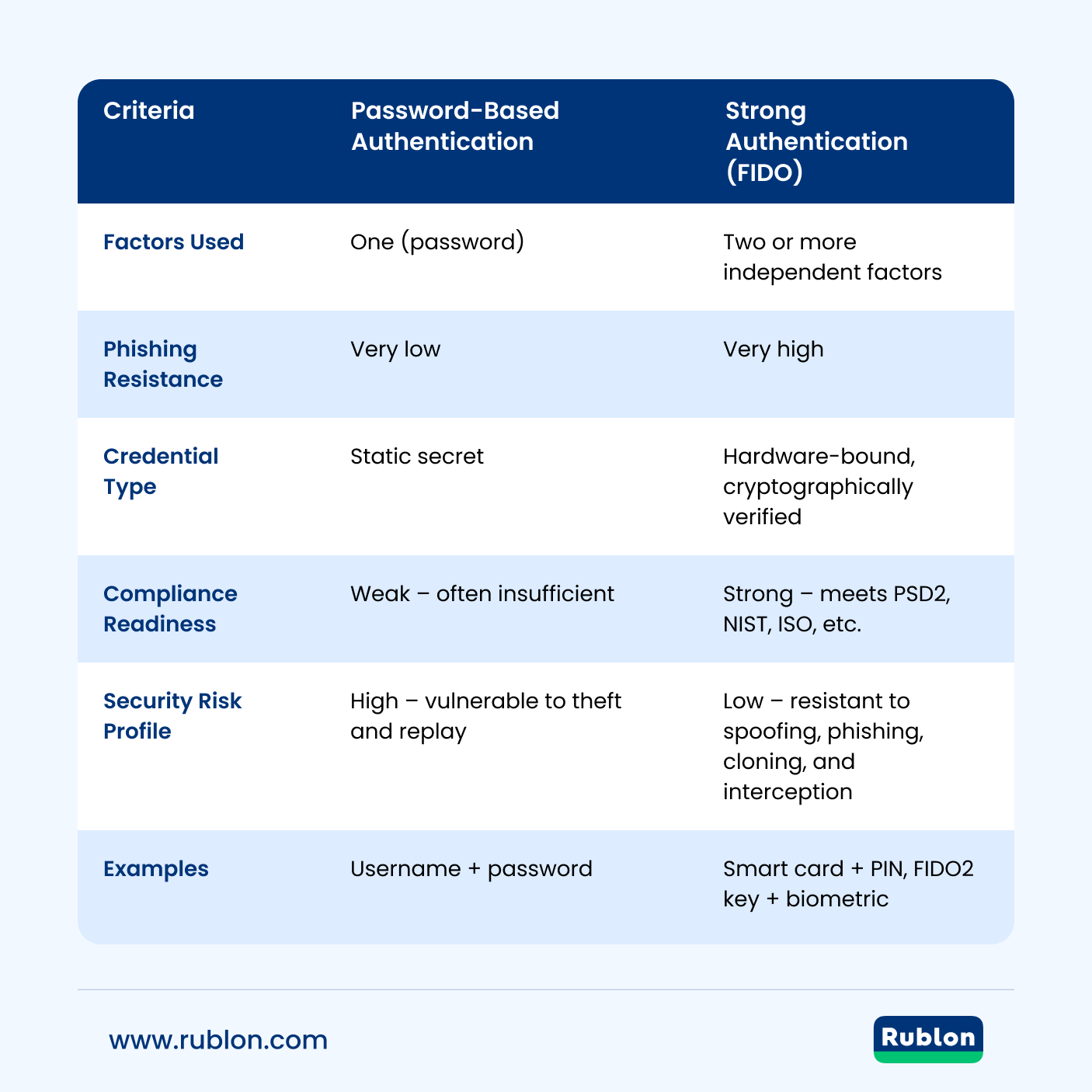
| Criteria | Password-Based Authentication | Strong Authentication (FIDO) |
| Factors Used | One (password) | Two or more independent factors |
| Phishing Resistance | Very low | Very high |
| Credential Type | Static secret | Hardware-bound, cryptographically verified |
| Compliance Readiness | Weak – often insufficient | Strong – meets PSD2, NIST, ISO, etc. |
| Security Risk Profile | High – vulnerable to theft and replay | Low – resistant to spoofing, phishing, cloning, and interception |
| Examples | Username + password | Smart card + PIN, FIDO2 key + biometric |
Strategic Business Benefits
- When you understand how to use strong authentication correctly, it enables smoother, secure access journeys without sacrificing user experience.
- Well-implemented strong authentication makes you more competitive by showing you take security seriously, which is an asset for vendor selection and enterprise contracts.
Core Components of Strong Authentication
Strong authentication is founded on three distinct categories of credentials. These components help you understand what strong authentication is and what authentication method is considered strong in practice.
Something You Know
This factor involves information the user must remember, such as a password, PIN, or security question. While still important, knowledge-based credentials alone are no longer sufficient for high-assurance access.
Something You Have
This factor covers physical or virtual assets that the user possesses. Examples include a hardware OTP token, a FIDO security key, a smartphone with an authentication app, and a smart card. When paired with a knowledge factor, the “something you have” factor substantially raises the bar for attackers. According to the FIDO Alliance statistics, password-only authentication still accounts for the majority of data breaches, so adding a possession factor is now widely recommended.
Something You Are
Also known as the inherence factor, it involves biometric data such as fingerprints, facial recognition, retina scans, and behavioral traits. While biometrics are often treated as high-assurance elements within strong authentication, the Authenticator and Verifier Requirements section of NIST Special Publication 800-63B makes clear that biometric characteristics are not secrets, can be obtained without consent, and remain subject to false matches, false non-matches, and presentation attacks. For that reason, biometrics are most effective when used in combination with another independent factor, rather than as a standalone authenticator.
Why Independence Of Factors Matters
To qualify as a robust, strong authentication scheme, each factor must be independent, meaning that compromising one should not affect the others. For example:
- A knowledge-based secret stolen via phishing is not enough if the attacker still needs the hardware token.
- A lost or stolen hardware token should not alone grant access if biometric verification is also required.
How Strong Authentication Works
Strong authentication works by requiring a user to verify their identity with at least two independent factors instead of relying on just one, such as a password. In practice, this usually means combining something the user knows with something the user has or something the user is. Because the factors are independent, compromising one factor does not allow an attacker to bypass or derive the other factor. This layered verification makes strong authentication far more effective at stopping phishing, credential theft, account takeover, and other common attacks against high-value systems and sensitive data.
Video: Learn How Strong Authentication Works
This 3‑minute story shows strong authentication as three gates that must all open, so a leaked password alone cannot unlock your account.

Best Methods for Strong Authentication
1. Phishing-Resistant Hardware Security Keys (FIDO & FIDO2)
One of the most robust strong authentication methods today is the use of hardware security keys based on the FIDO Alliance standards (such as WebAuthn). These devices leverage public-key cryptography and bind a private key material to the authenticator itself, making it resistant to credential phishing or replay attacks.
From a regulatory standpoint, authoritative guidance underscores this method’s strength. For example, the Cybersecurity & Infrastructure Security Agency (CISA) issued a fact sheet recommending “phishing-resistant multi-factor authentication (MFA)” and identifies FIDO-based keys as a top option.
When you must ensure the highest level of assurance for identity verification, FIDO hardware keys and FIDO2 passkeys offer clear compliance benefits and risk reduction for authentication.
2. Smart Cards And Cryptographic Logon
Smart cards remain an established strong authentication type for high-security environments, such as government systems or corporate networks. These devices store a certificate on the card (something the user has) and require a PIN or biometric (something the user knows or is) to unlock. The two-factor authentication nature aligns with many security frameworks.
Widely adopted implementations like the Common Access Card (CAC) and Personal Identity Verification (PIV) credentials exemplify smart card usage in regulated sectors, particularly within U.S. federal agencies. When combined with challenge-response protocols and certificate validation (e.g., certificate chain, revocation checks, EKU/policy filtering), smart card authentication achieves rigorous assurance levels. It fulfills many of the same strong authentication requirements as hardware security keys, with added policy and lifecycle controls mandated by government standards.
Key Types Of Strong Authentication
- Multi-Factor Authentication (MFA) – The most common strong authentication approach combines two or more authentication factors (something you know, something you have, something you are). For example, inserting a hardware token and entering a PIN is a stronger authentication process than a password alone.
- Phishing-Resistant MFA – A form of multi‑factor authentication that cannot be tricked by phishing pages, intercepted codes, or credential replay. It uses cryptographic authentication tied to the real website or service, so only genuine login attempts succeed. Examples include FIDO2/WebAuthn security keys and device‑bound passkeys.
- Hardware Tokens And Security Keys – Devices such as USB security keys and smart cards that store cryptographic keys offer high resistance to phishing and account takeover. For example, security keys compliant with the FIDO Alliance standards (WebAuthn / CTAP) are increasingly seen as best-in-class.
- Biometric Authentication – Methods using unique physical or behavioral traits (fingerprint, facial recognition, voice, keystroke dynamics) are now considered strong authentication when implemented with good security controls.
- Challenge-Response Authentication and Certificate-Based Authentication – Systems that use a cryptographic challenge, a protected private key, and a certificate chain deliver a strong authentication request from the server and a corresponding strong authentication response. This is especially used in enterprise and government scenarios.
How To Use Strong Authentication In Practice
- Select methods based on risk and value – Higher risk systems (e.g., administrative accounts, financial access) must use the strongest authentication methods available, like hardware tokens or certificate-based flows, rather than relying only on software tokens or SMS codes.
- Ensure integration and usability – Effective deployment of strong authentication methods requires seamless integration with existing identity and access management (IAM) systems and end-user training.
- Monitor and manage lifecycle – Tokens, biometric templates, certificates, and keys need lifecycle management (issuance, revocation, renewal). Poor lifecycle management undermines the effectiveness of strong authentication
- Suppress weaker methods when possible – For instance, disable SMS 2FA where stronger authentication is feasible, because SMS-based methods remain vulnerable to SIM swap and other bypass techniques.
How Strong Authentication Differs From Basic MFA
Many organizations ask about strong authentication vs MFA and assume they are the same. In most cases, MFA means adding a second factor, but strong authentication implies a higher standard: for example, cryptographic proof of identity, hardware-bound tokens, certificate chains, and phishing resistance. Simply adding a smartphone app as a second factor may raise security, but does not always meet the “strong authentication is required” threshold for the strictest regulatory compliance and high-risk applications.
How To Use Strong Authentication For All Accounts
What is the purpose of using strong authentication for all accounts? The answer is that extending strong authentication beyond high-risk and privileged accounts broadens your security posture, reduces attack surface, and moves an organization toward Zero Trust readiness. For example, applying hardware token-based authentication across all user accounts ensures that attackers cannot exploit weaker legacy methods on low-risk accounts and then pivot.
Security Enhancements and Best Practices for Strong Authentication
Progressive Authentication Adoption
- Start by ensuring that strong authentication is required for all accounts handling sensitive data, high privileges, and remote access.
- Implement risk-based authentication triggers so that the strongest methods (e.g., phishing-resistant keys) apply when risk is elevated, while simpler forms may suffice for low-risk scenarios.
- Make sure that your system is prepared to upgrade over time; legacy protocols (like FIDO1 & U2F) should be replaced with modern solutions (like FIDO2 & WebAuthn).
Phishing-Resistant Methods Matter
- Use technologies like FIDO2 security keys, passkeys, and hardware smart cards because they meet the highest standards of what strong authentication means. These methods are recommended by regulatory front frameworks, including the Payment Services Directive 2 (PSD2), which requires multi-factor authentication with independent elements.
- Push-based mobile second factors (including certified app notifications) are increasingly acceptable but should be combined with device-binding and other safeguards to meet the strength requirement in modern enterprise environments.
Start With Multi-Factor, Progress to Strongest Factor
- Make sure you require at a minimum two distinct authentication factors, drawn from independent categories (something you know, something you have, something you are). This aligns with the regulatory requirement under PSD2 for strong customer authentication, as well as overall best cybersecurity practices.
- Require employees and high-privilege users to use FIDO security keys by default.
- Use device posture checks, behavioral analytics, and adaptive access to elevate authentication when suspicious activity is detected.
Governance, Monitoring, and Policy Controls
- Maintain a clear authentication policy that defines which methods count as “strong authentication methods” and when they apply (e.g., financial access, administration, remote access).
- Regularly audit access logs and authentication logs to detect anomalies, such as misuse of weak authentication factors for high-risk operations.
- Enforce timely revocation of lost or compromised credentials (e.g., tokens, cards) and require re-enrollment with strong methods.
- Provide user training to explain why strong authentication is required and how users benefit from it, thereby boosting adoption and reducing friction.
Integration With Broader Identity Strategy
- Ensure that your strong authentication strategy ties into broader identity governance (e.g., privileged access management, identity-and-access management (IAM)). For example, link your key types of strong authentication to your IAM workflows.
- Use single sign-on (SSO) solutions where possible, but always layer in strong authentication as part of the SSO process for sensitive systems.
- Prepare for regulatory and compliance frameworks: for instance, the PSD2 requirement for strong customer authentication often maps into other frameworks like NIST SP 800-63 or ISO/IEC 27001, depending on your industry.
User Experience and Adoption
- Keep user experience in mind: introducing strong authentication should not create undue friction. Use passkeys or hardware security keys with simple UX flows to reduce employee resistance.
- Provide fallback options that are still strong (e.g., on-site token hardware) when users cannot access their primary method.
- Clearly communicate to users why the change is necessary and how it strengthens security. Use strong authentication examples, such as FIDO2 security key usage for remote login, to reinforce understanding.
Continuous Improvement
- Stay informed about emerging authentication threats and evolving standards. For example, phishing-resistant MFA is increasingly treated as the target standard in modern assurance programs. Official guidance from CISA urges organizations to adopt phishing-resistant MFA, Microsoft Entra defines phishing-resistant MFA as its most restrictive built-in authentication strength, and the EU’s NIS2 Directive reinforces the broader regulatory expectation for stronger cybersecurity risk-management and access controls.
- Evaluate the effectiveness of your authentication methods by measuring incidents prevented, reduction in credential-based compromises, and user satisfaction.
- Be ready to upgrade, as older forms (e.g., simple SMS codes) are increasingly considered weak; move to stronger factors proactively.
When Is Strong Authentication Required And Why
Mandatory Use Cases Across Industries
Strong authentication often isn’t optional. Many sectors require it by regulation or best-practice frameworks. For example, under Payment Services Directive 2 (PSD2) in the European Union, most electronic payment transactions must use “strong customer authentication” (SCA), meaning multi-factor authentication with independent elements. Similarly, guidance from the British Financial Conduct Authority (FCA) spells out when financial firms must apply SCA for account access, demonstrating that the requirement for strong authentication is not just best practice but regulatory.
More examples of regulations that require strong authentication can be found in the article: Which Industries Require Two-Factor Authentication (2FA)?.
Typical Scenarios Requiring Strong Authentication
- Accessing a payment account online or initiating a remote payment.
- High-risk actions such as changing beneficiary details, accessing privileged systems, or making large transfers.
- Remote access by third-party providers or service accounts with elevated rights.
- Environments subject to industry standards (e.g., financial services, healthcare, critical infrastructure) where strong authentication is required for Office 365 or similar enterprise policies apply.
Why It Matters: Fraud Prevention & Trust
- Strong authentication reduces the risk of credential theft, phishing, replay attacks, and unauthorized access.
- It fosters customer, partner, and regulator trust, showing that identity control meets a higher assurance threshold.
- Often, tools or services will require the statement “strong authentication is required” for compliance, audit, or vendor-selection criteria.
Planning For Strong Authentication Across All Accounts
While high-risk accounts obviously require strong authentication, expanding its use to broader account tiers helps reduce the overall attack surface.
- Ask: What is the purpose of using strong authentication for all accounts?
- Broad adoption means fewer weak links, fewer legacy access points, and stronger baseline security for the organization.
- Enterprises like Microsoft often set policies where strong authentication is required for all privileged or externally-accessible accounts.
Strong Customer Authentication (SCA) Explained
What Is Strong Customer Authentication?
Strong Customer Authentication (SCA) is a regulatory requirement under the Payment Services Directive 2 (PSD2) in the European Economic Area that mandates multi-factor authentication for certain payment-related processes. It defines authentication as using at least two independent elements:
- Knowledge (something the user knows – e.g., password or PIN)
- Possession (something the user has – e.g., mobile device, security token)
- Inherence (something the user is – e.g., fingerprint, facial recognition)
This requirement underscores how strong authentication is required in many financial services contexts.
When Is SCA Required?
- SCA applies when a payer accesses a payment account online, initiates an electronic payment, or performs a remote action with fraud risk.
- Merely enabling standard MFA does not always satisfy SCA; a compliant flow must meet PSD2’s technical standards (RTS), including dynamic linking of a transaction to a specific amount and payee.
- The regulatory framework gives a clear answer to the question of when strong customer authentication is required. As a result, organizations that handle payment accounts in the EEA must ensure that their access and transaction approval processes are designed to support SCA-compliant strong authentication.
How SCA Shapes Strong Authentication Practices
- SCA adds guidance on what counts as a strong authentication request: the method must ensure that the authentication factors are independent, and that the mechanism binds the transaction amount and payee (dynamic linking) when required.
- Operators must integrate technical assurance into authentication flows. For example, hardware tokens, certified biometrics, or device-bound passkeys may deliver SCA-compliant strong authentication methods.
- The guidance reflects the growing emphasis on strong authentication in payment scenarios, highlighting the need for methods that go beyond basic MFA, such as phishing-resistant credentials or cryptographic keys.
Implications for Organizations Outside Payments
- While SCA directly mandates strong authentication in a payment context, the principles apply broadly: whether you ask what the purpose of using strong authentication for all accounts is, or implement it for internal systems, the assurance-threshold framework remains useful.
- Internal enterprise policies (e.g., for Microsoft Entra, O365 privileged access) often mirror SCA by declaring that strong authentication is required for all accounts.
- Aligning your authentication strategy with SCA-style rules strengthens both regulatory compliance and operational resilience.
Strong Authentication vs. MFA: What’s the Difference?
Multi-factor authentication (MFA) means using at least two authentication factors. In many contexts, this is also what organizations mean by strong authentication. However, some frameworks use the term more narrowly to emphasize higher-assurance methods, while regulations such as PSD2 define strong customer authentication as multi-factor authentication based on independent elements.
Looking for a Phishing-Resistant MFA Provider?
Protect your IT infrastrcture from hackers with phishing-resistant multi-factor authentication.
Challenges and Emerging Trends in Strong Authentication
Common Challenges Organizations Face
Key Emerging Trends in Strong Authentication
- Passkeys and Passwordless Authentication: Next-generation credential approaches such as device-bound passkeys are gaining traction. These methods are highlighted under broader strong authentication frameworks and are examples of strong authentication.
- Adaptive and Continuous Authentication: Beyond the point-in-time login, systems are increasingly using behavioral biometrics and context intelligence to upgrade assurance post-login. Research shows promising advances in risk-based authentication and continuous authentication through behavioral metrics.
- Regulatory and Procurement Shift Toward Phishing-Resistant Methods: Government-issued guidance, such as that from the Cybersecurity & Infrastructure Security Agency (CISA), now emphasizes that “phishing-resistant MFA” (which meets strong authentication criteria) is preferred in procurement specifications.
- Hardware Keys and Certificate-Bound Credentials at Scale: There is broad industry momentum toward hardware security keys (FIDO2/U2F) and certificate-bound credentials (smart cards, tokens) as core components of strong authentication.
Planning for Future-Ready Strong Authentication
- Conduct a gap analysis: identify which accounts still rely on weak methods such as SMS OTP, and determine which strong authentication measures should be triggered as risk increases.
- Incorporate user feedback and usability testing to support adoption and ROI, so strong authentication does not become a barrier.
- Build a roadmap that schedules the deprecation of weak methods (e.g., SMS codes, legacy tokens) and the phased rollout of stronger systems (hardware keys, passkeys).
- Align procurement and policy with evolving regulatory expectations: state clearly that “strong authentication is required” in vendor RFPs and service level agreements.
- Monitor emerging threats and trends such as synthetic identity, device-spoofing, and credential stuffing; stay ahead by employing authentication methods that resist them (e.g., FIDO2 keys).
Conclusion
Strong authentication is no longer just a recommended security measure. It is becoming a practical requirement for protecting accounts, reducing exposure to phishing and credential theft, and meeting rising regulatory and business expectations. Organizations that adopt stronger methods, especially those based on independent factors and phishing-resistant technologies, can improve both security and trust while building a more resilient identity strategy.
Strong Authentication FAQ
What is an example of strong authentication?
A good example of strong authentication is signing in with a password and then confirming the login with a FIDO2 passkey or a mobile push approval. This is considered strong because it combines multiple layers of verification and makes unauthorized access much harder, even if the password is exposed.
What is the difference between strong and weak authentication?
Strong authentication uses reliable methods that are difficult to steal, guess, or replay, while weak authentication relies on methods that are easier to compromise, such as simple passwords, shared credentials, or basic security questions. The main difference is the level of resistance to phishing, credential theft, brute force attacks, and account takeover.
What is the strongest authentication?
The strongest authentication is generally phishing-resistant MFA based on public-key cryptography, such as FIDO2 passkeys and U2F & WebAuthn hardware security keys. These methods are stronger than passwords and one-time codes because they are designed to prevent credential reuse and greatly reduce the risk of phishing.
What is the strongest form of authentication?
The strongest form of authentication is hardware-backed, phishing-resistant multi-factor authentication that uses cryptographic credentials tied to a trusted device or security key. This approach provides a very high level of protection because it verifies both the user and the authenticity of the login flow.
What is considered strong authentication?
Strong authentication is any authentication process that uses at least two independent factors or a phishing-resistant cryptographic method that offers a comparable or higher level of protection. It should be resistant to common attacks and should not depend only on knowledge-based credentials such as passwords.
What is the difference between MFA and strong authentication?
MFA means using more than one authentication factor, but not every MFA setup is equally strong. Strong authentication refers to the actual security quality of the authentication method, so an MFA setup based on a password and a weak one-time code can still be less secure than phishing-resistant authentication based on passkeys or hardware keys.