
Risk-based authentication (commonly abbreviated as “RBA”) is a dynamic security method that evaluates contextual signals, such as device fingerprinting, IP address, geographical location, login time, and user behavior, in real time. Based on the calculated risk score of each login attempt, the system adapts the required level of verification. For example, a recognized device may allow access with just a password, while an unfamiliar device in a foreign location might trigger additional verification steps. In this way, RBA helps maintain strong protection without resorting to one-size-fits-all processes.
- Why Risk-Based Authentication Matters
- What Is Risk-Based Authentication?
- How Risk-Based Authentication (RBA) Works
- RBA vs. Passwords: What’s the Difference?
- RBA vs. Traditional MFA: What’s the Difference?
- Where RBA Is Applied: Use Cases & Policies
- RBA Policies For Implementation and Regulatory Compliance
- Benefits and Challenges of Risk-Based Authentication
- Key Pillars and Steps for a Risk-Based Approach
- Real-World Examples and Statistics for Risk-Based Authentication
- Implementation Best Practices and Considerations for Risk-Based Authentication
- Future Trends and the Role of Risk-Based Authentication
- Conclusion: Embracing Risk-Based Authentication for Today and Tomorrow
- Frequently Asked Questions About Risk-Based Authentication
Why Risk-Based Authentication Matters
- Enhanced User Experience: Low-risk transactions proceed seamlessly; only high-risk attempts trigger deeper checks.
- Stronger Risk Mitigation: Controls focus where abuse is most likely, not on every login.
- Better Resource Allocation: Security teams prioritize high-risk access over routine logins.
- Future-Ready Architecture: RBA supports Zero Trust and context-aware identity strategies.
- Credential Attacks Are Rising: Static methods no longer suffice against modern threats. For example, Verizon’s 2025 DBIR reports that about 88% of breaches in the “Basic Web Application Attacks” pattern involved stolen credentials, while IBM X-Force’s 2026 Threat Intelligence Index highlights attackers scaling credential-driven operations, including large volumes of credentials tied to modern services (e.g., AI/chat tooling) being traded and abused.
- User Expectations Are High: People want security without constant friction.
- Regulatory Pressure Is Growing: Adaptive authentication is becoming a compliance must.
In short, risk-based authentication aligns security controls with risk levels rather than treating all access equally. In the next sections, we will explore how it works, how it differs from traditional authentication methods, and how organizations can implement it effectively.
What Is Risk-Based Authentication?
Defining the Concept
Risk-based authentication (RBA) evaluates the context of each login attempt, such as device, location, behavior, and IP address, to determine how much verification is required. Instead of treating every login the same, the system assigns a risk score and adapts accordingly.
The Components of a Risk-Based Approach
- Contextual Signals: Attributes of the session, like device fingerprint, geolocation, login timing, and previous user behavior.
- Risk Scoring Engine: Computes a risk value based on signals and predetermined thresholds.
- Adaptive Response: Based on the risk score, the system may allow access, require step-up verification, or outright deny the attempt.
Why RBA Is Recommended
Risk-based authentication (RBA) is already used by major online services and is recommended in standards as a way to make password-based logins more robust.
At the same time, authoritative frameworks such as the National Institute of Standards and Technology (NIST) digital identity guidelines indicate that risk-based authentication offers “reasonable risk-based assurances” when verifying the same user across sessions.
RBA Key Features at a Glance
- Dynamic: Login challenges change based on context and risk, not static rules.
- Adaptive: The system adjusts verification severity: low-risk logins move smoothly, high-risk attempts trigger stronger measures.
- User-Centered: Legitimate users experience less friction, improving usability while maintaining stronger protection.
- Policy-Driven: Organizations define when higher assurance is required based on assets and risk thresholds.
How Risk-Based Authentication (RBA) Works
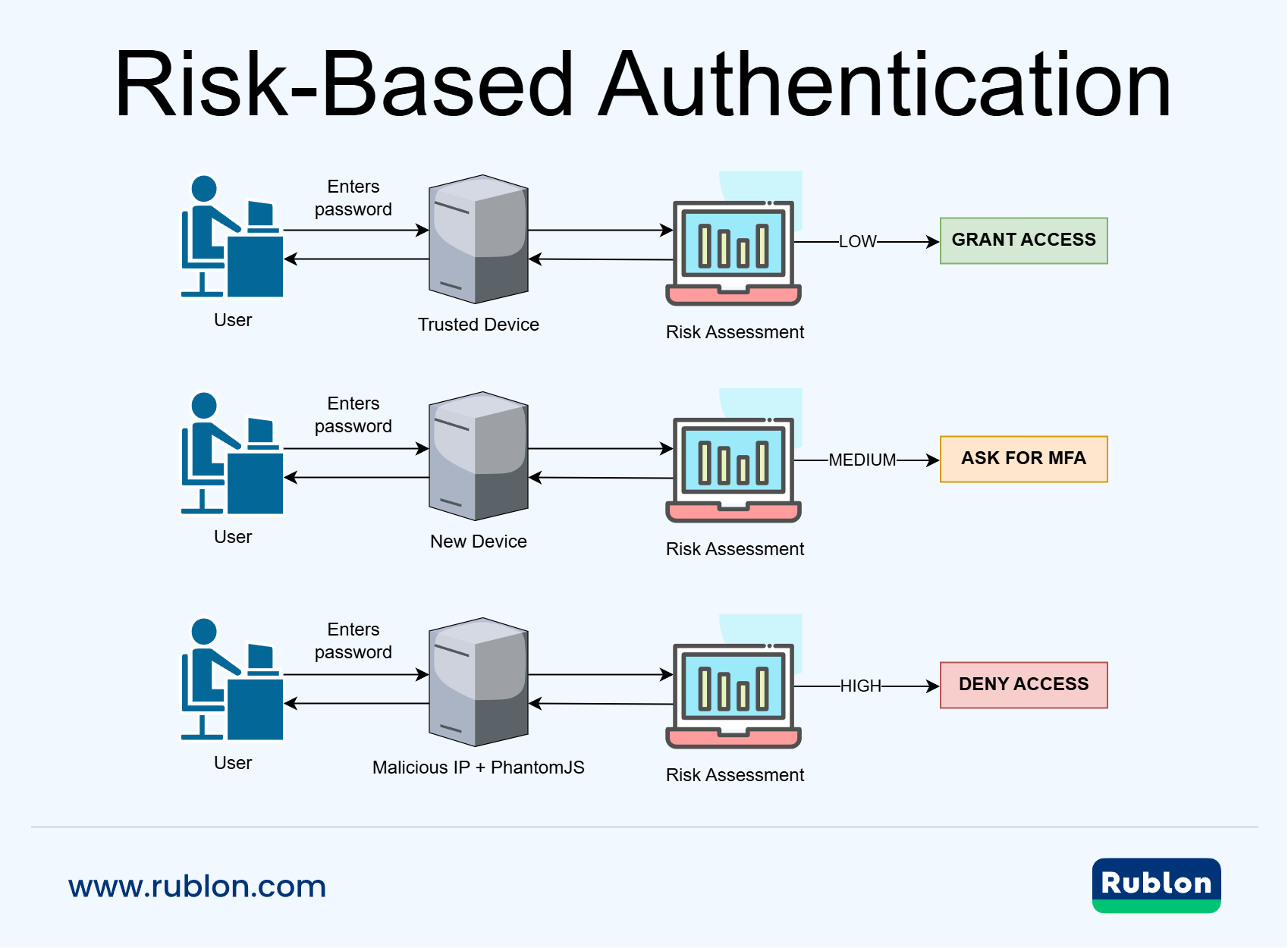
Evaluate Contextual Signals
Effective risk-based authentication begins with collecting and analyzing contextual signals that help assess the legitimacy of a login attempt. These signals include device posture, geolocation, network attributes, login velocity, and historical behavior patterns. By monitoring such attributes, systems can detect when a login deviates from a user’s normal profile. A Data-driven Long-term Study on Risk-based Authentication Characteristics found that organizations monitoring more than 200 behavioral features achieved significantly higher detection accuracy.
Key signal categories:
- Device & Environment – Known device? Rooted mobile? Secure network?
- Location & Network – Unfamiliar IP, unusual country, anonymized proxy?
- Behavior – New transaction size? Time of day unusual?
- Historical Context – Is this user’s typical login behavior?
Calculate a Risk Score
Once contextual data is gathered, a risk engine assigns a risk score based on predetermined thresholds and machine-learning models. This scoring mechanism quantifies how likely the login attempt is to be fraudulent or malicious. For instance, low-risk attempts may proceed with minimal friction, while high-risk attempts trigger stronger verification.
Typical outcomes based on risk score:
- Allow – Access granted with minimal friction
- Challenge – Step-up authentication (e.g., second factor, biometric)
- Block – Deny access or require manual review
Adapt the Authentication Response
The heart of risk-based authentication lies in adapting the response based on that risk score. This adaptive behavior distinguishes RBA from fixed-policy authenticators.
- Low-risk scenarios: Known device, expected behavior → simple password or single-factor pass
- Medium-risk scenarios: New device, unusual time → require additional verification such as a one-time code or push notification
- High-risk scenarios: Unfamiliar device, suspicious location, large-value transaction → enforce strong measures (hardware token, biometric) or block access entirely
This approach balances user convenience with security, reducing friction for trusted users while applying stronger safeguards for elevated risk.
Real-World Workflow Example
- User enters credentials
- System evaluates device and geolocation; risk score is calculated
- Decision tree: if risk < threshold → access granted; if risk ≥ threshold → challenge or block
- If challenged, the user completes step-up authentication, or access is denied
Dynamic authentication policies empower organizations to strengthen access control without compromising user convenience.
RBA vs. Passwords: What’s the Difference?
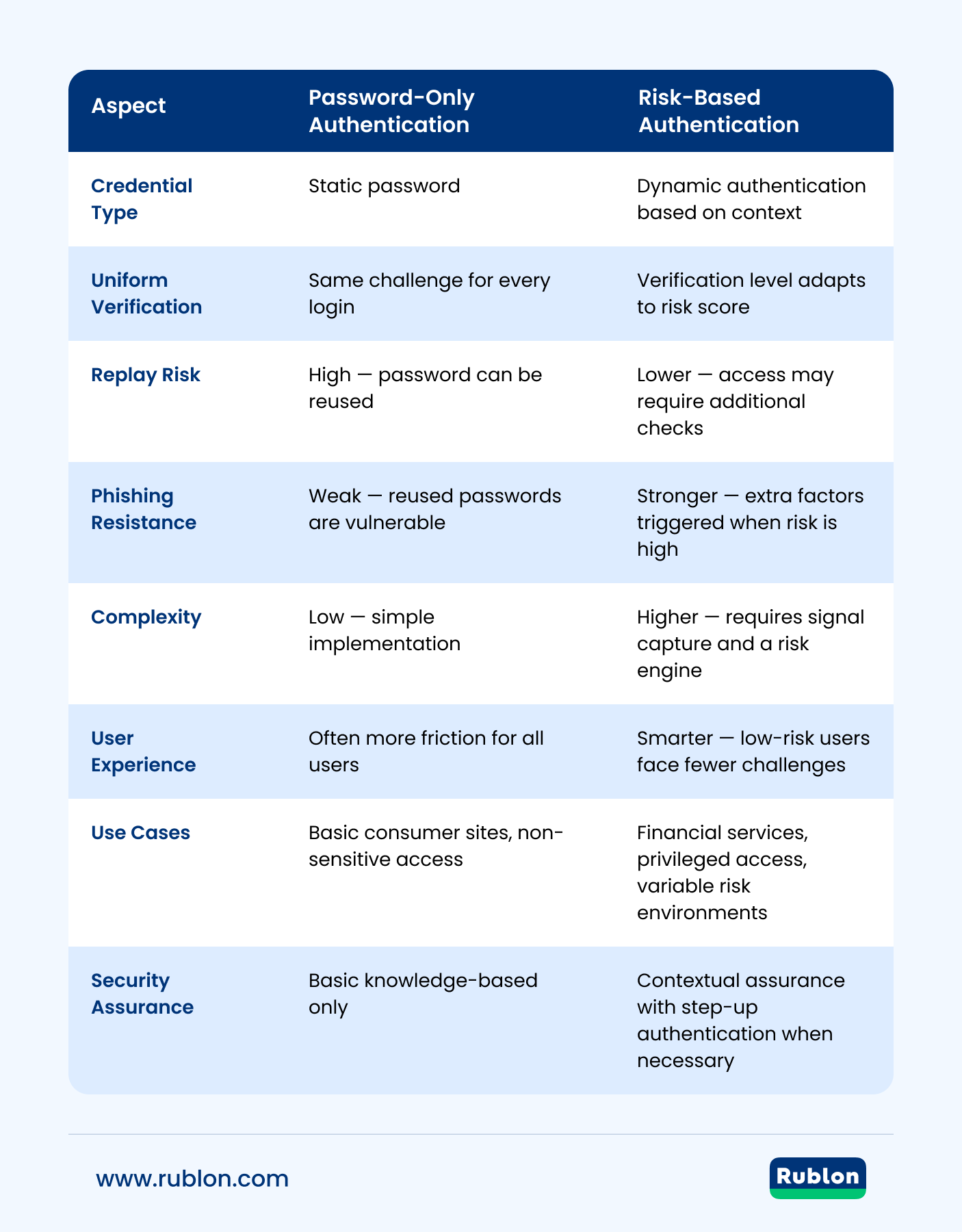
| Aspect | Password-Only Authentication | Risk-Based Authentication |
| Credential Type | Static password | Dynamic authentication based on context |
| Uniform Verification | Same challenge for every login | Verification level adapts to risk score |
| Replay Risk | High — password can be reused | Lower — access may require additional checks |
| Phishing Resistance | Weak — reused passwords are vulnerable | Stronger — extra factors triggered when risk is high |
| Complexity | Low — simple implementation | Higher — requires signal capture and a risk engine |
| User Experience | Often more friction for all users | Smarter — low-risk users face fewer challenges |
| Use Cases | Basic consumer sites, non-sensitive access | Financial services, privileged access, variable risk environments |
| Security Assurance | Basic knowledge-based only | Contextual assurance with step-up authentication when necessary |
RBA vs. Traditional MFA: What’s the Difference?
Traditional multi-factor authentication (MFA) requires users to present two or more distinct authentication factors, such as a password, a hardware token, or a biometric sample, every time they log in. This approach adds a layer of security beyond a password, but it treats all access attempts the same, regardless of context. In contrast, risk-based authentication (RBA) adapts the level of verification required for each access attempt based on its assessed risk. Instead of a fixed set of authentication steps each time, the system evaluates device, location, and behavioral anomalies to decide whether a simple login is sufficient or a more stringent challenge is needed.
Key distinctions:
- Context-aware: RBA uses signals such as unfamiliar IP addresses, atypical device types, and unusual login times, while traditional MFA does not.
- Adaptive step-up: RBA triggers stronger authentication only when risk is elevated; MFA applies the same control for all attempts.
- Efficiency and user experience: With RBA, low-risk logins can proceed with minimal friction, while high-risk attempts face more rigorous checks. Traditional MFA often places an unnecessary burden on all users.
When Each Approach Makes Sense
- When to use traditional MFA:
- For high-value access where uniform control is needed.
- In organizations with simple risk models or regulatory mandates requiring multi-factor authentication for all logins.
- When to use RBA:
- In environments with diverse device types, remote workforces, and fluctuating risk profiles.
- Where a balance between usability and security is critical, and the organization can process contextual signals in real time.
Combining MFA and RBA for Maximum Assurance
Rather than viewing RBA and MFA as alternatives, many effective identity strategies deploy both. For example:
- Use RBA to assess risk context and determine whether step-up MFA is required.
- Use traditional MFA as a baseline fallback when a user’s device or situation lacks sufficient context.
- In this way, organizations can enforce strong multi-factor controls only when needed and avoid overburdening users on trusted devices.

Where RBA Is Applied: Use Cases & Policies
Banking and Financial Services
In banking, risk-based authentication (RBA) serves as a critical line of defense. Financial institutions face sophisticated threats, and regulators emphasize stronger identity verification for high-risk transactions. Federal Deposit Insurance Corporation guidance notes that banks should implement “stronger authentication procedures” when risk assessments indicate single-factor credentials are inadequate.
FFIEC guidance (issued on behalf of U.S. federal banking regulators, including the FDIC) emphasizes that financial institutions should apply stronger authentication and layered controls when risk assessments indicate that single-factor credentials are not sufficient for internet-facing banking access and transactions.
At the same time, the NIS2 Directive raises the bar for cyber risk management across the EU: as part of risk-mitigating measures, it explicitly points to access control and the use of multi-factor authentication or continuous authentication solutions (where appropriate), which reinforces the practical argument that static password-only logins should not be the sole barrier protecting systems and data.
At the same time, the NIS2 Directive raises the bar for cyber risk management across the EU: as part of risk-mitigating measures, it explicitly points to access control and the use of multi-factor authentication or continuous authentication solutions (where appropriate), which reinforces the practical argument that static password-only logins should not be the sole barrier protecting systems and data.
Use-cases in banking and financial services:
- Logging into online banking from a new country triggers a step-up authentication challenge.
- Initiating a large fund transfer from an unfamiliar device results in an automatic block or prompts additional verification.
- Real-time risk scoring enables seamless access for low-risk users while applying stricter checks to high-risk activities.
E-Commerce and Retail
Online retailers implement RBA to prevent account takeovers and fraudulent transactions.
Examples include:
- A first-time checkout from a brand-new device may trigger a dynamic authentication challenge.
- A high-value order shipped to an unfamiliar address often requires additional verification.
- Even when a user is logged in, an unusual purchasing pattern can prompt a silent adjustment to their risk score.
Enterprise Access and Remote Work
With remote work on the rise, enterprises face diverse device types, unknown networks, and evolving threat vectors. In addition, the remote access software employees use adds a powerful attack vector. Risk-based authentication helps tailor access based on context. For instance:
- When an employee logs in from a corporate laptop during regular working hours, access is granted with minimal friction.
- If a contractor attempts to log in from an overseas network at an unusual time, the system may trigger step-up authentication or deny access altogether.
- When an employee logs in from a country known for high botnet activity and automated attacks, access is denied.
- Risk-based authentication (RBA) supports identity-centric security models and helps reduce dependence on static access rules.
RBA Policies For Implementation and Regulatory Compliance
Effective organizations establish risk-based authentication policies to define when and how stronger verification applies. Key policy elements include:
- Risk thresholds: Define what “low-risk” vs “high-risk” means in your context.
- Signal scope: Specify device, location, and behavior signals monitored.
- Response matrix: Map risk levels to appropriate actions (allow/challenge/block).
- Audit and review cadence: Periodic review of thresholds, false-positive rates, and user experience.
- Regulatory frameworks such as Payment Services Directive 2 (PSD2) allow low-risk transactions to be exempt from strong customer authentication (SCA) when real-time risk analysis deems risk minimal.
Benefits and Challenges of Risk-Based Authentication
Real-World Benefits of RBA
- Improved Security with Less Friction: By evaluating contextual signals and adapting authentication flow, risk-based authentication enables stronger controls only when needed. A study (Evaluation of Real-World Risk-Based Authentication at Online Services Revisited) shows that RBA can protect against account-takeover attacks on large-scale services while remaining nearly transparent for legitimate users.
- Enhanced User Experience: Since low-risk attempts may pass through with minimal verification, users avoid unnecessary friction, boosting satisfaction and reducing support calls.
- Efficient Use of Security Resources: Instead of over-investing in high-assurance checks for every login, organizations can apply advanced verification only when the risk warrants it, optimizing operational cost and focus.
- Supports Modern Security Architectures: Risk-based authentication aligns with zero-trust and adaptive access frameworks by introducing context-aware verification into identity systems.
Key Challenges and Considerations
- Privacy Implications of Contextual Monitoring: Collecting data such as device fingerprint, IP, location, and behavioral features raises privacy concerns. A detailed study found RBA systems must balance usability, security, and user privacy carefully.
- Complex Implementation and Tuning: Deploying RBA requires establishing signal collection, defining thresholds, risk-scoring logic, and adaptive response policies. Small misconfigurations can degrade security or introduce poor user experience.
- False Positives and User Friction: If risk thresholds are too strict or signals are misinterpreted, legitimate users may be challenged or blocked, leading to a poor experience or lost customers.
- Lack of Standardized Metrics and Visibility: Many services use RBA, but few publish data on their performance, making benchmarking and selecting vendors challenging.
Balancing Trade-Offs Wisely
- Define clear risk-threshold tiers so low-risk scenarios proceed smoothly while high-risk attempts receive elevated controls.
- Use privacy-aware signal collection, minimizing sensitive data exposure and maintaining transparency with users.
- Monitor key metrics like challenge rate, false challenge rate, and user complaint volume to iterate and refine policy.
- Combine RBA with baseline multi-factor verification policies so that risk-scoring enhances rather than replaces foundational controls.
Key Pillars and Steps for a Risk-Based Approach
The Four Foundational Pillars
Adopting risk-based authentication successfully depends on four core pillars. These act as structural supports for a system that adapts to risk intelligently, rather than applying a one-size-fits-all control.
- Identify and Assess Signals: Collect context signals such as device type, geolocation, login velocity, and behavioral patterns. Analysis helps determine the likelihood and impact of each access attempt.
- Allocate Response Based on Risk: Based on risk scores, the system dynamically applies zero-challenge access, step-up verification, or blocking. This matches the effort to the threat level.
- Monitor, Review, and Refine: Continuous feedback, audit logs, and user-experience metrics are critical to evaluate false-positive rates, challenge accuracy, and system effectiveness.
- Governance and Policy Framework: Strong governance ensures that thresholds, signal definitions, and response actions align with business risk appetite and regulatory requirements.
Three-Step Implementation Roadmap
Transitioning to a full-scale risk-based authentication model can be approached in three sequential steps:
- Baseline and Pilot:
- Map existing authentication flows and baseline risk signals.
- Run a pilot with a low-risk segment to allow the system to learn normal behavior and calibrate risk thresholds.
- Scale and Integrate:
- Expand signal collection to wider user segments, devices, and transaction types.
- Integrate the response engine into the identity platform and align with step-up mechanisms (second factor, biometric, token).
- Optimize and Govern:
- Track key performance indicators (KPIs), such as challenge rate, user drop-off after challenge, and security incident reduction.
- Review periodically and refine risk profiles, signal weighting, and response actions.
Strategic Considerations for Effective Implementation
- Data Quality and Coverage: The more comprehensive and accurate contextual signals are, the better the risk model works. Device fingerprinting, anomaly detection, and historical behavior data are key components.
- User-Experience Balance: Excessive challenges for legitimate users degrade experience. Policy must maintain low friction for trusted access while protecting against high-risk scenarios.
- Regulatory Alignment: Many industries require “strong customer authentication” for high-risk transactions. Organizations must define policies that comply with relevant frameworks while applying adaptive responses.
- Continuous Improvement Culture: Threats evolve rapidly. A risk-based authentication program must include mechanisms for learning from incidents, tuning thresholds, and reinvesting lessons gained into the risk engine.
Real-World Examples and Statistics for Risk-Based Authentication
Prevalence of RBA in Practice
A Study of Multi-Factor and Risk-Based Authentication Availability highlights the growing, but still uneven, adoption of risk-based authentication. A comprehensive survey of 208 popular websites found that only about 22% of sites automatically block a highly suspicious login attempt. Meanwhile, only ~42 % of those sites supported any form of multi-factor authentication (MFA) or risk-based authentication (RBA) at all. This demonstrates that although RBA is recognized as a viable strategy, many organizations have yet to realize its full value.
The Usenix study shows uneven adoption: only 42% of sites support MFA or RBA, 22% automatically block suspicious logins, while 58% offer no advanced authentication at all.
Data-Driven Insights from Large-Scale Deployments
In one long-term study of a large online service, researchers analyzed more than 31 million login attempts and over 3.3 million user accounts. They found that RBA configurations could significantly reduce reliance on continuous multi-factor prompts while still maintaining strong protection.
Key takeaways:
- RBA rarely triggers for legitimate users when well-configured.
- More subtle signals (behavioral patterns, device reuse) improve both usability and security.
Industry Patterns and Benchmarks
- Large-scale analyses show that many organizations are moving toward adaptive authentication, where access checks scale with risk rather than being uniform.
- Usability research found that users perceive RBA as more user-friendly than many mandatory MFA models. A lab study with 65 participants confirmed this.
What These Statistics Mean for Organizations
- The low prevalence of automatic blocking indicates a gap between theory and practice: many services support RBA or MFA but do not automatically enforce actions for high-risk logins.
- The large-scale data show RBA can scale and remain usable, but only if deployment is tuned correctly.
- Organizations should benchmark their challenge rate, false-positive rates, and user drop-off after step-up prompts, using available studies as reference points.
Implementation Best Practices and Considerations for Risk-Based Authentication
Establish Clear Metrics and Governance
Effective risk-based authentication begins with a well-governed policy framework and measurable objectives. Define relevant KPIs such as challenge rate, false-positive rate, login completion rate, and number of blocked high-risk attempts. Consistently track these metrics to ensure your system aligns with business objectives and user expectations.
Strong governance includes documenting your risk tier thresholds, determining roles and responsibilities, and reviewing policies regularly to adapt to changes in user behavior or the threat environment.
Feed Rich Data and Contextual Signals
A robust risk-based authentication solution depends on high-quality data inputs. Collect signals such as device posture, geolocation, network reputation, login patterns, and user role context. These signals empower the system to assign risk scores accurately and decide the appropriate response.
Ensure your data sources are reliable, timely, and comprehensive so the adaptive response you implement is based on actionable intelligence, not assumptions.
Tune and Iterate Continuously
Implementing risk-based authentication is not a one-time project, but a continuous process of refinement. As NIST Special Publication 800‑63B states, “RBA is not ‘set-and-forget’; regular review and adjustment are essential.”
Key activities include:
- Reviewing challenge outcomes and user feedback
- Adjusting thresholds based on real-world performance
- Testing for false negatives
- Updating signals and context parameters to match evolving attack patterns
Balance User Experience With Security
One of the most valuable aspects of risk-based authentication is its potential to reduce friction for trusted users. At the same time, it must maintain high assurance for risky access attempts. Design your workflow so that low-risk users proceed smoothly, while high-risk users receive stronger verification.
Be transparent with users about why some logins might trigger additional steps. Provide clear support channels for those who encounter step-ups unexpectedly. This approach builds trust and prevents frustration.
Integrate With Broader Security Architecture
Risk-based authentication is most effective when integrated into a broader identity and access framework. Tie it into existing multi-factor authentication (MFA), single sign-on (SSO), privileged access management (PAM), and zero-trust models. According to the U.S. Cybersecurity and Infrastructure Security Agency (CISA)’s recommended best practices for administrators, contextual risk tools should be embedded into identity workflows and act as part of an overall layered security posture.
Integration ensures seamless operation across platforms and allows risk signals to inform access decisions throughout the session, not just at login.
Address Privacy and Regulatory Obligations
Your implementation must account for privacy considerations and compliance requirements. Contextual signal collection (such as device data or behavioral analytics) can raise privacy concerns. Organizations must be transparent about data use, retention, and user rights.
Additionally, compliance frameworks such as PCI DSS, GDPR, and PSD2 increasingly expect adaptive access controls and risk-based verification. Ensure your policies align with regulatory mandates and document your risk-based authentication strategy for audit readiness.
Future Trends and the Role of Risk-Based Authentication
The Rise of Adaptive Identity and Continuous Trust
As organizations evolve toward more dynamic security models, risk-based authentication (RBA) becomes foundational in enabling adaptive identity systems. Industry analysts note that fixed authentication rules are losing ground to identity-centric approaches where access decisions rely on real-time context and user behavior.
For example, ISACA, a globally recognized authority in IT governance and cybersecurity, emphasizes that “adaptive identity is the future of IAM, and it must be dynamic, risk-aware, and context-driven to support modern access control”.
Because RBA evaluates contextual signals and user activity continuously, it aligns well with this shift, moving beyond “login only” decisions toward ongoing monitoring and evaluation.
Integration With Zero Trust and Identity-Centric Architectures
Risk-based authentication is increasingly integrated into broader frameworks such as the “never trust, always verify” model of zero trust architecture (ZTA). These frameworks emphasize identity, device posture, continuous risk assessment, and adaptive controls.
In such environments:
- Access decisions consider how users and devices behave during a session rather than only at sign-in.
- RBA engines feed into the risk scoring and policy enforcement layers of zero-trust systems.
- Authentication becomes a component of trust decisions throughout the user journey, not just at the entry point.
Emerging Technologies Driving RBA Innovation
Several technical trends are driving the next generation of risk-based authentication:
- Machine learning and behavioral analytics: Systems learn typical user behavior over time and detect anomalies in real time.
- Federated and privacy-preserving models: New research on a Federated Learning-based Framework for Risk-based Authentication proposes frameworks where risk scoring can be performed without centralizing sensitive user data.
- Context-enriched signals: Device health, micro-location, biometrics, and environmental context will enhance signal coverage, making risk scoring more accurate and dynamic.
- Continuous authentication: Rather than one-time authentication, systems will continuously validate users and devices over the session lifecycle.
Preparing for the Future: Strategic Recommendations
To stay ahead, organizations should consider the following proactive steps:
- Adopt a phased roadmap: Start with RBA for high-risk access scenarios, scale signal coverage gradually, and integrate into your broader identity strategy.
- Architect for integration: Ensure RBA engines can feed into identity access management (IAM), privileged access, and zero-trust enforcement.
- Stay data-savvy and privacy-respecting: As new signals and analytics are introduced, ensure privacy and compliance by design, especially when machine learning is used.
- Measure and evolve: Monitor metrics like step-up frequency, false challenges, user dropout, and security incident reduction. Iterate to improve both user experience and security posture.
Conclusion: Embracing Risk-Based Authentication for Today and Tomorrow
Risk-based authentication offers a powerful way to protect digital access while preserving user experience. By assessing context, adapting the challenge, and aligning verification effort with actual risk, organizations achieve both stronger security and greater user convenience.
Your Next Steps
- Review your current authentication flows: identify which access scenarios require the most trust.
- Consider piloting risk-based authentication for high-risk logins and transactions to test signal coverage and user experience.
- Ensure you have governance: define risk thresholds, monitor key metrics, and refine thresholds over time.
- Embed RBA into your identity architecture: it works best when integrated with MFA, SSO, and zero-trust frameworks.
Follow this roadmap, and you will be ready to move from traditional access controls to smarter, risk-aware authentication that balances security, user experience, and compliance.
Remember: Risk-based authentication isn’t a one-time solution, but rather a journey into smarter access management. Start now and evolve as your attack surface and business demands change.
Frequently Asked Questions About Risk-Based Authentication
What Does RBA Stand For in Security?
RBA in security stands for Risk-Based Authentication. It refers to an adaptive authentication method that evaluates contextual signals from each login attempt, such as device, location, network, and behavior, and adjusts the verification requirements accordingly.
What Is an Example of a Risk-Based Approach?
An example of a risk-based approach: A user logs in from their usual office desktop on a weekday morning. Risk is low, so only a password is required. Later that week, they attempt to log in from a foreign country on a new device at midnight. Risk is high, triggering additional verification or access denial.
What Is an Example of Risk-Based Authentication?
A bank’s mobile app detects a login from a new device in a different country while a large transfer is requested. The system assigns a high risk score and demands biometric verification and a one-time passcode before proceeding. This is risk-based authentication in action.
What Is an Example of Adaptive Authentication?
Adaptive authentication is another name for the same concept: For example, an employee is using their known device from their typical location, and only a password is requested. But when they try from a coffee-shop WiFi abroad, the system adapts and prompts for a hardware token or other step-up factor.
What Is Risk-Based Verification?
Risk-based verification refers to the process of validating a user’s identity and transaction based on the calculated risk level. If risk is above a threshold, the verification method is elevated (e.g., from password only to MFA or biometric) to maintain proper assurance.
What Does RBA Mean in Banking?
In banking, RBA means that the authentication strength is matched to the risk of the customer’s access or transaction. For example, routine balance checks might require minimal verification, while a large international wire transfer from a new device would require strong authentication. It supports both usability and regulatory compliance.
What Is RBA Authentication?
RBA authentication is the implementation of Risk-Based Authentication: a system that analyzes login or transaction context, computes a risk score, and enforces a response aligned with that risk. So, the system replaces fixed authentication rules with flexible controls based on threat level.
What Is a Risk-Based Strategy?
A risk-based strategy means allocating resources, controls, and verification steps in proportion to the assessed risk. For authentication, this means applying the strongest checks where risk is high and preserving user experience where risk is low.
What Is a Risk-Based Approach?
A risk-based approach is a methodology in which actions, controls, and decisions are determined based on risk analysis rather than a “one size fits all” rule. In identity and access management, this means authentication adapts to risk rather than enforcing the same steps every time.
What Is an Example of Risk-Based Thinking?
Imagine a company granting remote access only after evaluating device security, user behavior, and network context. They allow trusted users seamless access and challenge others. This shows risk-based thinking because the decision depends on assessed risk.