
Public Key Infrastructure (PKI) is the backbone of modern digital security, a structured system that enables authentication, encryption, and digital signatures by binding public keys to real-world identities through certificates. At its core, PKI (public key infrastructure) relies on Certificate Authorities, Registration Authorities, certificate issuance workflows, and revocation mechanisms like CRLs and OCSP to maintain trust.
In this guide, you’ll find:
- A comprehensive public key infrastructure overview, walking you through how PKI works from key generation → CSR → issuance → chain validation → revocation → renewal
- Deep dives into architecture and components of PKI
- Real-world use cases – TLS (HTTPS), email (S/MIME), code signing, device identity, and mTLS / PKI authentication
- Exploration of PKI as a Service (PKIaaS), PKI tokens / smart cards, post-quantum migration, and operational best practices for governance at scale
You’ll also find clear, straightforward answers to common questions such as “What are PKI certificates?” and “How do you implement public key infrastructure?” Throughout, we refer to authoritative standards (for example, RFC 5280 & RFC 9618 on X.509 profiles) and discuss current industry changes, such as OCSP becoming optional, the shift to shorter certificate lifetimes, and preparing for post-quantum cryptography. The goal is to present this with precision and clarity so both newcomers and seasoned professionals can learn something new about PKI.
Key Findings (at a Glance)
- PKI is more than SSL/TLS – it supports identity, encryption, and signature across multiple domains (web, IoT, email, mTLS).
- Core building blocks matter – Certificate Authorities, Registration Authorities, trust stores, CRLs/OCSP, certificate chains.
- Certificate lifecycle is complex, not linear – issuance, validation, renewal, revocation all demand design and automation.
- Modern shifts reshape PKI operations – while OCSP is becoming optional in certain contexts like web PKI due to increased use of stapling and short-lived certificates, it remains a requirement in many environments. Meanwhile, short-lived certificates are gaining favor, and PQC migration is underway.
- Implementations vary by environment – on-prem (e.g., AD CS), PKIaaS, or hybrid; tokens and smart cards may be required.
- Governance & risk are central – large-scale PKI needs policies, audits, key protection, and incident readiness.
- Future proofing is imperative – crypto agility and preparing for post-quantum cryptography are no longer optional.
- Key Findings (at a Glance)
- What Is Public Key Infrastructure (PKI)? Definition & Meaning
- Public Key Infrastructure Overview: Where PKI Shows Up in Real Life
- PKI Components & Architecture
- How PKI Works: Step by Step (Key Generation to Renewal)
- Public Key Infrastructure Certificates (X.509): Types, Fields & Use
- Authentication with PKI: From Logins to mTLS
- PKI vs. CA vs. SSL/TLS: Clearing Up Common Confusions
- PKI Architecture Models & Trust Models (Hierarchical, Bridge, Mesh, Hybrid)
- Implementing PKI: Practical Routes (On-Prem, Cloud, Hybrid)
- Operations, Governance & Risk: Running PKI at Scale
- Modern PKI for Developers & Platforms
- Public vs Private PKI: When to Use Which
- PKI Tokens & Smart Cards (PIV, USB Tokens, “PKI Device”)
- Post-Quantum & Crypto-Agility: The 2026 Roadmap
- Frequently Asked Questions (FAQ)
What Is Public Key Infrastructure (PKI)? Definition & Meaning
PKI Explained
Public Key Infrastructure, or PKI, is the framework of roles, policies, hardware, software, and procedures that lets entities (people, servers, devices) bind public keys to identities in a trustworthy way. It enables authentication, encryption, and digital signatures on insecure networks.
Key Concepts You Should Know
- Asymmetric Cryptography: PKI depends on public/private key pairs: the public key is shared openly, the private key is kept secret. This enables both encryption and signature verification.
- Certificates (X.509): A certificate asserts that a particular public key belongs to a subject (domain, person, device) and is signed by a trusted CA, following the X.509 profile defined in RFC 5280.
Roles & Trust Anchors
- Certificate Authority (CA): issues and signs certificates, vouching for identity.
- Registration Authority (RA): verifies identity information before a CA issues a certificate.
- Trust Store / Root CA: software or systems maintain a set of trusted root certificates; all certificate chains are validated against those roots.
Validating & Revoking Certificates
- Certificate Chain Validation: Clients build a chain from the certificate presented back to a trusted root. They check validity periods, extensions, issuer relationships, and revocation status. This is standardized in RFC 5280’s “path validation” algorithm.
- Revocation Mechanisms: If a certificate should no longer be trusted (compromise, key rotation, etc.), clients check via CRL (Certificate Revocation List) or OCSP (Online Certificate Status Protocol).
Why PKI Is Essential Today
PKI underlies many common security functions:
- HTTPS / TLS for web security
- Email and document signing (S/MIME)
- Device identity in IoT, VPNs, and network hardware
- Mutual TLS (mTLS) inside internal architectures
- Routing security (RPKI) to validate BGP routes
Because it is grounded in standards (e.g., RFC 5280 & RFC 9618) and widely adopted across systems, PKI offers a consistent foundation for secure communication in everything from your browser to large enterprise networks.
As the chart below shows, the PKI market is projected to more than double from 2025 to 2030.
Forecast growth of the global PKI market from USD 7.42 billion in 2025 to USD 19.49 billion in 2030 (CAGR ≈21.3%) based on data from Mordor Intelligence.
Public Key Infrastructure Overview: Where PKI Shows Up in Real Life
1. PKI for Web Servers & HTTPS (TLS / SSL)
One of the most familiar uses of PKI is securing web traffic via HTTPS. A web server presents a PKI certificate (TLS server certificate) that chains to a trusted root CA. The browser validates the chain and checks revocation status before trusting the server. This is the public-web instance of public key infrastructure in cryptography and one of the foundational public key infrastructure use cases. Even when people say “SSL certificate,” what they’re really invoking is PKI doing its job in the TLS layer.
2. Email & Document Signing (S/MIME, Code Signing)
PKI enables digital signatures on emails and documents, helping recipients verify authenticity and integrity. In S/MIME, senders sign or encrypt email messages using certificate bindings. In software delivery, code signing certificates ensure that software hasn’t been tampered with since it was signed. These are classic examples of PKI authentication and PKI digital signature use.
3. Device Identity, VPN & Wi-Fi Access
Beyond web and email, PKI supports device-level identity. Certificates can be issued to network devices, VPN endpoints, or Wi-Fi access points, ensuring that only authorized devices can connect. This is part of PKI for security and PKI in networking.
For example, an enterprise Wi-Fi network can require client certificates (device/user) to connect, rather than just passwords.
4. mTLS & Mutual Authentication
In modern microservices or zero-trust architectures, mutual TLS (mTLS) is common. Both client and server present certificates, and each side verifies the other. This is a strong form of PKI-based authentication with no shared secrets, just certificate validation.
5. Internet Routing (RPKI)
A specialized variant of PKI, called Resource Public Key Infrastructure (RPKI), secures Internet routing (BGP). It binds IP prefixes and AS numbers to certificate holders, helping prevent route hijacking and misconfiguration.
Though niche, RPKI is a real, deployed use of PKI infrastructure in networking at a global scale.
6. IoT & Edge Devices
PKI is critical for Internet of Things (IoT) deployments, where each device needs a cryptographic identity. Devices get certificates at manufacturing or provisioning time, then use them for secure communication, firmware updates, and data authentication.
Because IoT environments often have constrained resources, efficient certificate profiles, renewal policies, and lightweight validation (e.g., short-lived certificates) become important.
PKI Components & Architecture
| PKI Component | Purpose / Role | Key Risks / Threats | Mitigation & Controls |
| Certificate Authority (CA) | Issuing, signing, and revoking certificates | CA compromise, unauthorized issuance, key theft | Use offline root, HSMs, multi-party control, strict audits, and separation of duties |
| Registration Authority (RA) | Identity proofing and validation of CSR | Weak identity validation, impersonation, fraud | Strong proofing workflows (documents, in-person, multi-factor authentication), logging, and QA checks |
| Certificate Repository / Directories | Host CRL, certificates, and directory services | Availability denial, tampering, stale data | Redundant servers, integrity checks, access controls, signed CRLs/OCSP |
| Revocation / Validation Service (CRL / OCSP) | Communicate certificate validity/revocation | Latency, denial of service, stale responses | Geographically distributed OCSP responders, CRL caching, monitoring, fallback paths |
| Trust Store / Root Store | Locally trusted roots & anchors | Malicious root inclusion, root trust abuse | Control root additions, test chain policies, and certificate pinning in critical apps |
| Hardware Security Module (HSM) / Key Vault | Secure key generation and protection | Key extraction, side-channel attacks, cloning | Use certified HSMs (FIPS-level), tamper detection, periodic key rotation, physical security, and role separation |
| Certificate Management System / Automation | Lifecycle handling (enroll, renew, revoke) | Automation bugs, rogue issuance, credential sprawl | Role-based access, QA environments, version control, monitoring, and audit logs |
Core Components Defined
- Certificate Authority (CA): The CA is the trust-anchor entity that issues and signs certificates binding public keys to identities. Without a trustworthy CA, the system fails.
- Registration Authority (RA): The RA handles identity proofing and validation, acting as a gatekeeper before the CA issues a certificate. It does not itself sign certificates.
- Certificate (X.509) / Digital Certificate: A structured document that includes identity (subject), issuer, validity period, public key, and extensions (e.g., key usage, SAN). These adhere to the X.509 standard.
- Trust Store / Root CA: A repository of trusted root certificates built into operating systems, browsers, or devices. All certificate chains must ultimately resolve to a root in the trust store.
- Revocation & Validation Services: Mechanisms like CRL (Certificate Revocation List) and OCSP (Online Certificate Status Protocol) let clients check whether a certificate is still valid or revoked.
- Supporting Infrastructure:
- Hardware Security Modules (HSMs) or secure vaults to protect private keys
- Certificate management systems (issuance, lifecycle automation, logging)
- Directories / Repositories to store and distribute certificates, CRLs, or OCSP responses
Hierarchies & Trust Models
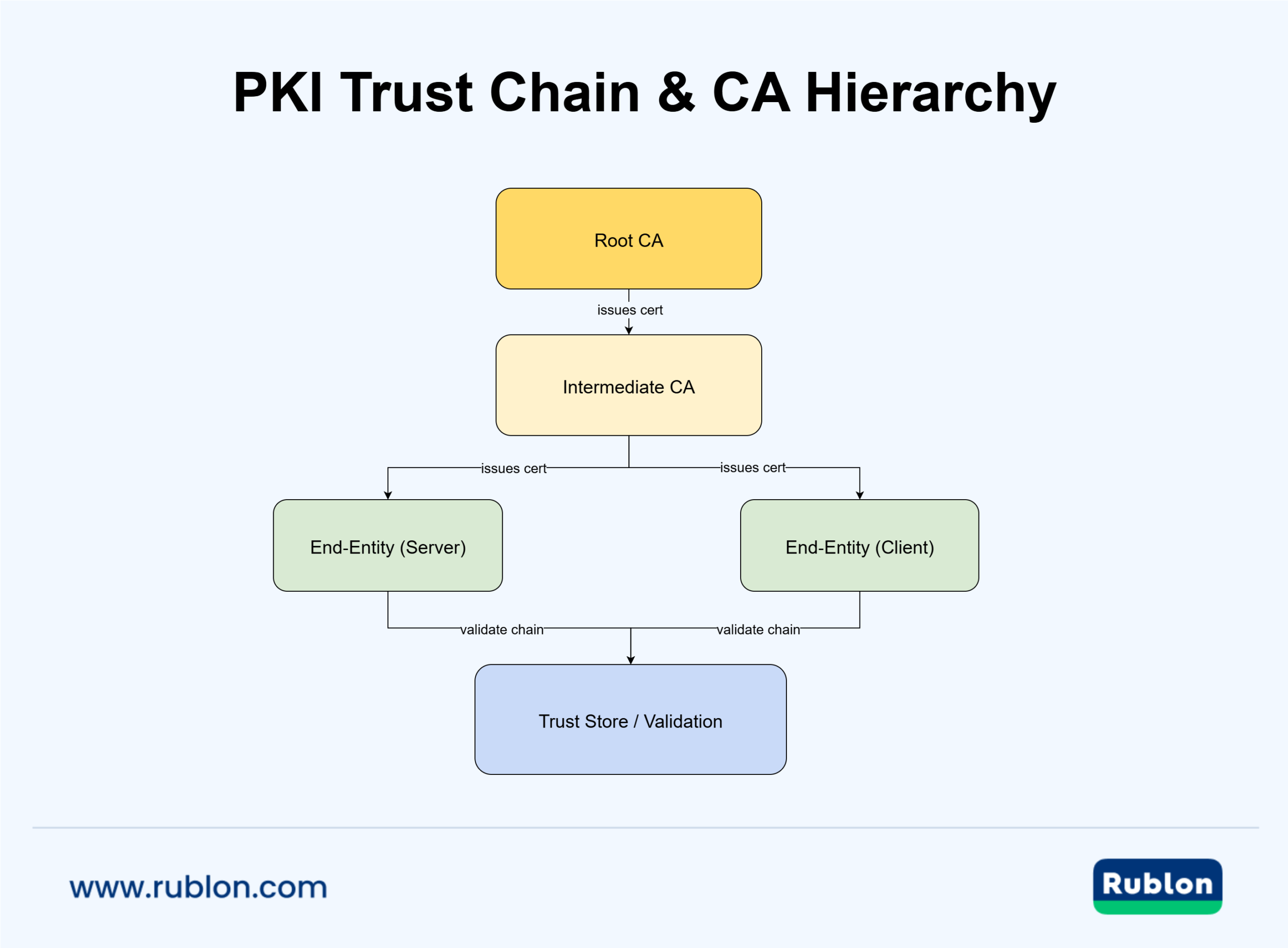
- One-Tier / Single CA Hierarchy: A single CA functions as both root and issuing CA. Easy to manage but high risk: compromise means full system collapse. Microsoft warns this isn’t recommended for production environments.
- Two-Tier Hierarchy (Root + Subordinate CA): The root CA operates offline, issuing certificates only to subordinate/issuing CA(s). The issuing CAs operate online and issue end-entity certificates. This pattern balances security and manageability and is recommended for many deployments.
- Three-Tier & Multi-Tier Models: Introduce one or more “policy CA” layers between root and issuing CAs. This allows segmentation (e.g., one policy CA for user certificates, another for device certificates) and containment in case of CA compromise, though it adds complexity and operational overhead.
- Other Trust Architectures:
- Bridge & Mesh models: multiple CA domains cross-certify to enable trust domains to interoperate.
- Decentralized / DPKI variants: use non-hierarchical trust (e.g., blockchain logs) to reduce dependence on centralized CAs.
Securing the Root & Offline CA Strategy
Root CAs are critical. If compromised, the entire PKI collapses. For that reason:
- They are often kept offline / air-gapped (powered down or physically secured), only brought online under strict controls for key ceremonies or CRL signing.
- Use strict controls, multi-person access, tamper-evident hardware, and HSMs to protect root key material.
- Intermediate/subordinate CAs limit blast radius: if a subordinate is compromised, only its branch is affected, not the root or other branches.
Trust Anchors, Root Stores & Chain Validation
- Operating systems, browsers, and devices ship with pre-trusted root CA certificates in their trust stores. When a certificate chain ends in one of those roots, it is considered valid (if other checks pass).
- Chain validation requires checking the signature of each certificate in the chain, its validity period, extension constraints, and revocation status.
- Trust models must ensure that subordinate CAs cannot exceed the authority of their root, through constraints and policy enforcement.
Component Relationships & Workflow Summary
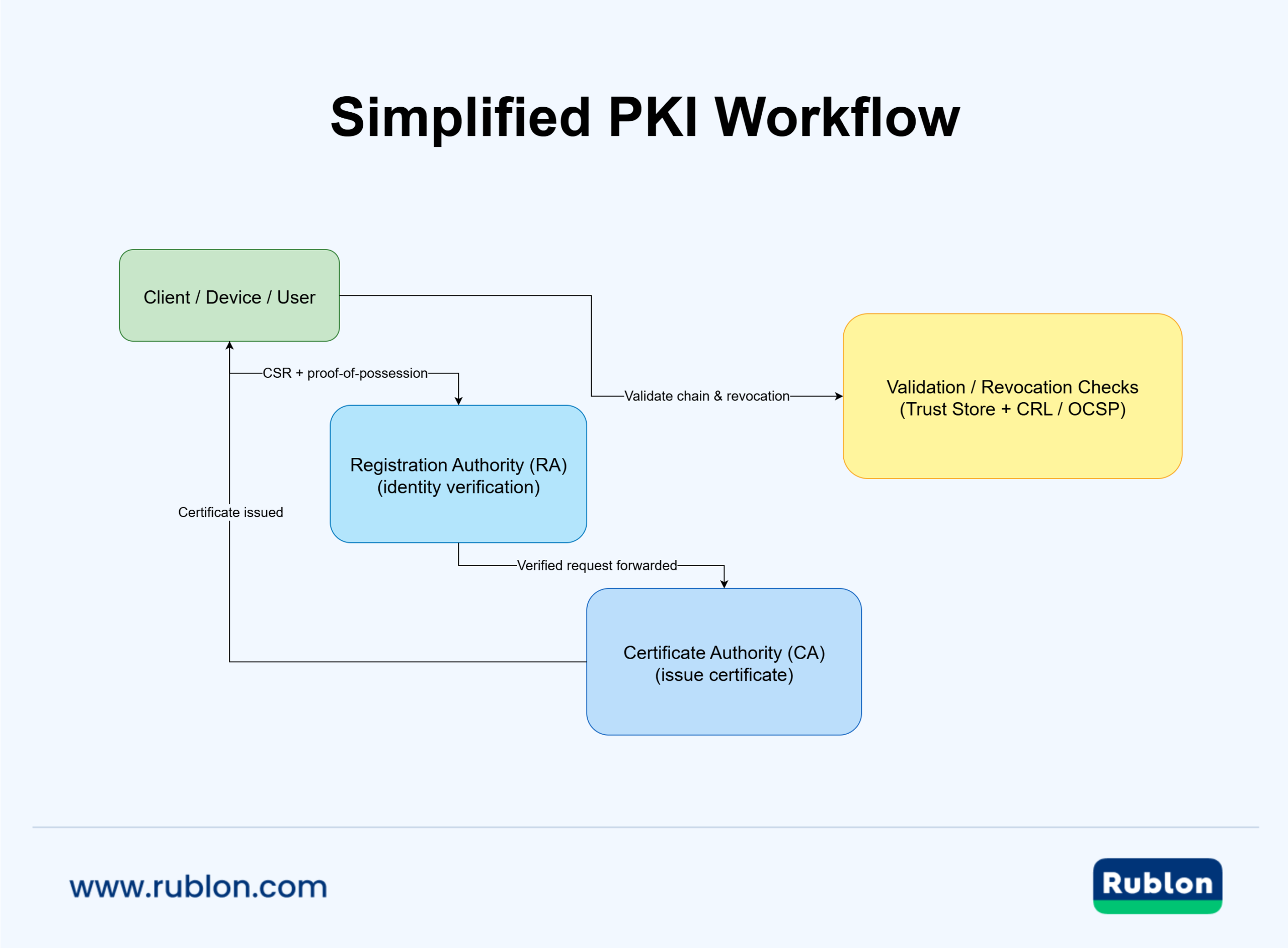
Here’s a simplified flow to see how these pieces interconnect:
- Registration Request: RA receives a certificate request (CSR), verifies identity.
- Certificate Issuance: CA signs and issues the certificate under X.509 structure.
- Publication / Distribution: Certificate, CRL, or OCSP response stored in repositories or published.
- Validation via Clients: Clients build chain → check signatures → check revocation → check constraints.
- Renewal & Revocation: CAs and management systems rotate certificates or revoke them as needed.
How PKI Works: Step by Step (Key Generation to Renewal)
1. Key Pair Generation
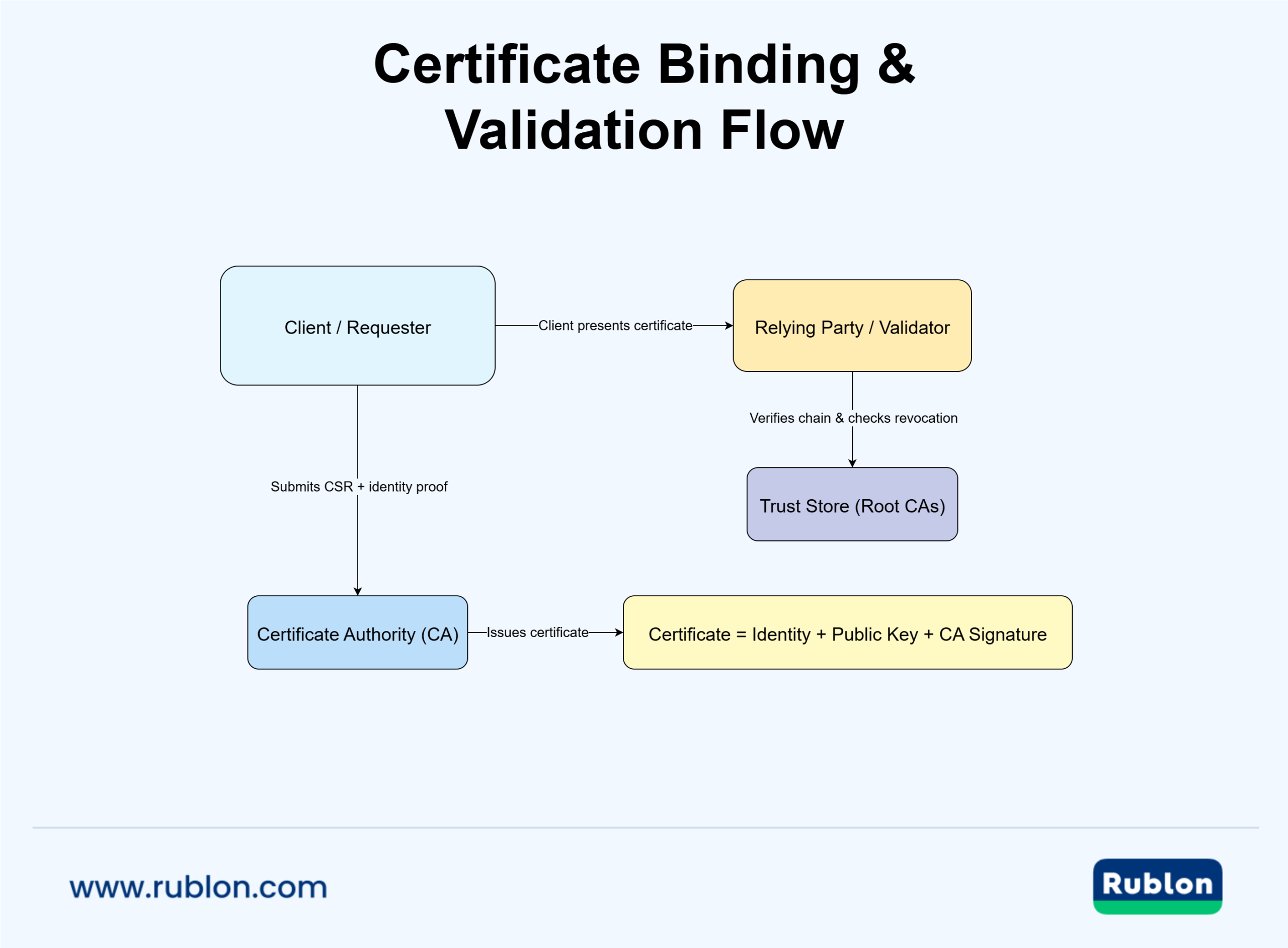
Whenever a certificate is requested, the first step is generating a public/private key pair. The private key stays safely held (often inside an HSM or secured vault), while the public key is included in a Certificate Signing Request (CSR). The CSR contains identity information (subject name, SAN, public key, extensions) and is digitally signed by the private key to prove key ownership.
2. Cert Request & Identity Verification
Once a CSR is submitted, the Registration Authority (RA) or validating component verifies the identity of the requester. That could involve domain validation (for TLS certificates), organization proofing, or other identity checks, depending on certificate assurance level.
3. Certificate Issuance & Signing
After verification, the Certificate Authority (CA) signs the CSR, producing an X.509 certificate. The certificate includes data like validity period, key usage, extended key usage, and constraints (e.g., name constraints). The CA’s signature cryptographically binds the subject’s public key and identity.
For automated PKI operations (especially in web environments), many systems use ACME (Automatic Certificate Management Environment, RFC 8555) to streamline issuance, renewal, and revocation without manual intervention.
4. Certificate Distribution & Publication
Once the certificate is issued, it is distributed to the requester (e.g., installed on a server or device) and published in certificate repositories if needed (for example, CRL distribution, OCSP responders, or certificate directories).
5. Chain Building & Trust Validation
Clients (browsers, services, devices) receiving a certificate must validate it. This involves:
- Building a chain of trust from the end-entity certificate up through intermediate CAs to a root CA that the client already trusts
- Verifying each signature in the chain
- Checking the certificate’s validity period (notBefore / notAfter)
- Inspecting certificate extensions (constraints, key usage)
- Ensuring no unknown critical extension breaks processing
- Checking revocation status via CRL or OCSP
The algorithm for certification path validation, as defined in RFC 5280, provides strict rules for these checks. Many platforms and security systems enforce RFC 5280 compliance in path validation.
6. Revocation, Expiry & Renewal
Because certificates aren’t valid forever, PKI must support invalidation and refresh:
- If a certificate must be revoked (for example, key compromise, change of ownership), a CRL (Certificate Revocation List) or OCSP (Online Certificate Status Protocol) is published. Clients check these to know whether a certificate should no longer be trusted.
- Some CAs are making OCSP optional or pushing for short-lived certificates to reduce reliance on revocation checks.
- Before a certificate expires, the owner generates a new CSR and repeats the issuance (renewal). Automation (primarily via ACME) is becoming the norm to avoid outages and human error.
7. Automated Workflows & Scaling with ACME
In large environments or for public web PKI, automation is essential. The ACME protocol allows clients and certificate authorities to interact using a standardized API over HTTPS, handling issuance, renewal, and revocation of certificates transparently.
Using ACME:
- The client proves control over a domain or identity (via challenge types like HTTP-01, DNS-01).
- The CA validates proofs, signs the certificate, and delivers it.
- The client installs it and later renews automatically before expiry.
This workflow dramatically reduces operational risk and human error.
Public Key Infrastructure Certificates (X.509): Types, Fields & Use
| Certificate Type | Key Usage / EKU Examples | Typical Use Case | Notes / Constraints |
| TLS Server Certificate | digitalSignature, keyEncipherment; EKU: serverAuth | Web servers, APIs | Must include SANs (domain names/IPs) |
| TLS Client Certificate / mTLS | digitalSignature; EKU: clientAuth | Client authentication, API clients | Validated in two-way TLS flows |
| Code / Software Signing | digitalSignature; EKU: codeSigning | Software release, updates | May have strict policy constraints |
| Email / S/MIME | digitalSignature, keyEncipherment; EKU: emailProtection | Signed/encrypted email | Recipient must support S/MIME |
| Device / IoT Certificate | digitalSignature, keyEncipherment; EKU: clientAuth, deviceAuth | Device identity (provisioning, secure comms) | Must handle constrained device constraints |
| CA / Intermediate CA | keyCertSign, cRLSign; EKU could include certSign, CRLSign | Authority certificate in the PKI chain | Should not have unrestricted EKU; constraints apply |
| Root CA Certificate | keyCertSign, cRLSign; often minimal EKU or no EKU | Trust anchor | Typically offline and highly secured |
What Is an X.509 Certificate?
An X.509 certificate is the digital credential issued under PKI that ties a public key to a verified identity (domain, user, device). It is signed by a trusted Certificate Authority (CA), so clients can trust the binding. Modern PKI almost always uses X.509 version 3 certificates, which support extensible metadata through certificate extensions. (RFC 5280 defines the profile and rules.)
Rather than “SSL certificates” or “TLS certificates,” there’s really one certificate format (the X.509 structure) used in contexts such as TLS/HTTPS, S/MIME email, code signing, IoT identity, and more.
Types of X.509 Certificates
Different certificate classes serve different roles in the PKI ecosystem:
- End-entity (leaf) certificates: Issued to servers, end users, devices, or applications. They are not allowed to issue other certificates (i.e., CA: false).
- CA (Certificate Authority) certificates: Can issue and sign other certificates. In a hierarchy, you have root or intermediate CAs.
- Root CA certificates: Self-signed trust anchors. Their identities are preinstalled in trust stores (OS, browser).
- Intermediate (subordinate) CA certificates: Signed by root or higher CA. Create structure and contain damage if compromised.
- Cross-certificates: Issued between different PKIs to establish trust bridges.
- Attribute / Policy certificates (less common) that carry policy attributes or roles beyond standard X.509 identity binding.
Core Certificate Fields (Base Structure)
Every X.509 v3 certificate contains a standard set of fields, which form the “To Be Signed” (TBS) data:
- Version: Indicates X.509 version (typically v3).
- Serial Number: Unique per issuing CA; used for identifying certificates and handling revocation.
- Signature Algorithm: The algorithm used by the CA to sign the certificate.
- Issuer: Distinguished Name (DN) of the CA that issued this certificate.
- Validity Period: notBefore and notAfter timestamps defining when the certificate is valid.
- Subject: Distinguished Name of the certificate holder (domain, entity, device).
- Subject Public Key Info: The public key being certified, with algorithm metadata.
- Issuer Unique Identifier / Subject Unique Identifier (rarely used).
- Extensions: A flexible container to carry additional metadata (required for modern PKI).
These fields and their semantics are governed by the X.509 and PKIX profiles in RFC 5280.
Key Certificate Extensions & Their Purposes
Extensions allow X.509 certificates to encode richer constraints or capabilities. Notable extensions include:
- Basic Constraints: Indicates whether this certificate is a CA and any path length limits.
- Key Usage: Bit flags restricting the permitted operations (e.g., digitalSignature, keyEncipherment, certificateSign).
- Extended Key Usage (EKU): Specifies higher-level uses (e.g., TLS server auth, code signing, email protection).
- Subject Alternative Name (SAN): Additional identity names (DNS names, IP addresses, URIs).
- Authority Key Identifier / Subject Key Identifier: Linking keys across chains.
- Certificate Policies: Policy OIDs that describe assurance levels or constraints.
- CRL Distribution Points: URLs from which CRLs can be fetched.
- Authority Information Access (AIA): Links such as OCSP responder URLs or issuing CA certificates.
- Name Constraints, Policy Constraints, Inhibit AnyPolicy: Advanced constraints to limit certificate scope or policy inheritance.
Extensions may be critical or non-critical: critical means clients must understand them or reject the certificate; non-critical extensions can be ignored if unrecognized.
Real-World Use Cases & Typical Certificate Usages
Here are some of the most common real-world uses of certificates in PKI:
- Let’s Encrypt: Issues millions of TLS certificates annually, exemplifying large-scale PKI deployment in the real world.
- TLS / HTTPS (web servers/clients): Use leaf certificates whose EKU includes “TLS Web Server Authentication”.
- Client TLS / mTLS: Certificates used by clients or services to authenticate themselves (EKU: clientAuth).
- Email / S/MIME: Certificates enable signing and/or encrypting emails.
- Code & Document Signing: Certificates assert the authenticity of software and documents.
- Device / IoT Identity: Certificates embedded in or provisioned to hardware (for secure boot, device attestation, encrypted telemetry).
- RPKI / Routing Security: Certificates that bind IP prefixes or AS numbers to authorities, helping validate routing announcements.
Example Walkthrough: TLS Leaf Certificate
Consider a TLS certificate for “www.example.com”:
- Version: 3
- Serial Number: unique per CA
- Issuer: e.g., “CN = ExampleCA, O = ExampleOrg, C = US”
- Subject: “CN = www.example.com, O = ExampleCo, C = US”
- Validity: from 2025-08-01 to 2025-11-01
- Public Key: e.g., ECDSA P-256
- Extensions:
- SAN: DNS = www.example.com, DNS = example.com
- Key Usage: digitalSignature, keyEncipherment
- EKU: TLS Web Server Authentication
- AIA: OCSP responder URL, issuing CA certificate URL
- CRL DP: CRL distribution point URL
Clients validate this certificate by building its chain, checking that every extension is allowed, verifying signatures, and confirming revocation status.
Authentication with PKI: From Logins to mTLS
PKI Authentication: From Certificates to Logins
In many enterprise settings, PKI authentication replaces or complements passwords and one-time tokens. A user or device presents a certificate signed via PKI, proving identity without revealing secrets. This certificate-based (PKI-based authentication) method is especially strong because the private key never leaves the device, mitigating phishing and replay attacks.
In classic PKI authentication flows:
- The client (user or device) requests a certificate from the CA (via RA verification).
- The certificate is installed securely (e.g., in a browser or system keystore).
- When logging in, the client sends the certificate and signs a challenge with the private key.
- The server validates the chain, checks revocation status, and ensures the certificate was issued to the correct identity.
- If checks pass, authentication is granted.
Many sectors, such as financial systems or government identity systems, mandate certificate-based login (e.g., smart card login).
Hardware PKI tokens (smart cards, USB tokens) often hold private key material in tamper-resistant hardware and enforce PINs or biometrics. Using tokens raises the bar for PKI token security and hardens this mode of authentication.
Why Use PKI for Authentication
- Phishing resistance & strong identity binding: Attackers can’t just trick users into typing credentials; the private key must be present.
- Centralized revocation & lifecycle control: Compromised certificates can be revoked immediately.
- No password management overhead or resets: Certificates avoid “forgot password” risks (though infrastructure must handle renewal).
- Granular authorization mapping: Certificates can embed attributes or roles (via extensions) for fine-grained access control.
Mutual TLS (mTLS): Two-Way PKI Authentication
Mutual TLS is the strongest form of PKI authentication in network communications. In mTLS, both client and server present certificates and validate each other during the TLS handshake.
How mTLS Works in Brief
- The server presents its certificate to the client (as in standard TLS).
- The client responds by sending its own certificate and signs a handshake message to prove control of its private key.
- The server validates the client’s certificate (chain, revocation, constraints).
- If validation succeeds, both sides trust the other, and a secure channel is established.
mTLS is widely used in internal APIs, microservices architectures, zero-trust systems, and machine-to-machine (M2M) communication. Because neither side relies on shared secrets, it scales well in distributed systems.
Standards & Modern Use
In OAuth 2.0, RFC 8705 defines Mutual-TLS Client Authentication, where client certificates are bound to access tokens. When a client presents a certificate during a TLS handshake, the server can ensure that any associated token was issued to that certificate. This is often used in API security frameworks and federated authentication setups.
Common Challenges & Considerations
- Certificate proliferation (sprawl): In mTLS systems, many clients need certificates. Automating issuance/rotation is critical to avoid management chaos.
- Revocation latency: Clients must check for reversed (revoked) certificates reliably. Delays or stale CRLs/OCSP responses may allow invalid certificates to persist.
- Trust anchoring & CA scopes: Servers need to trust client CAs or trust stores, which may differ from the public Web PKI.
- Hardware constraints & token management: PKI tokens must be issued, replaced, or revoked. When tokens fail, fallback logic must be secure.
- Operational complexity: Logging, monitoring, backup, audit trails, and incident response become more challenging in a PKI-authenticated environment.
PKI vs. CA vs. SSL/TLS: Clearing Up Common Confusions
What PKI Really Is (vs. the Others)
PKI (public key infrastructure) is the framework or ecosystem for managing key pairs, issuing and revoking certificates, and enforcing trust policies. It defines the roles (Certificate Authorities, Registration Authorities), processes (validation, issuance, revocation), and mechanics (chain validation, revocation checking) needed to operate a certificate ecosystem. Because of its breadth, PKI is often conflated with its constituent pieces, but PKI is the umbrella, not just one component.
What a CA (Certificate Authority) Is Within PKI
A CA is a core component in the PKI. It is the entity responsible for signing certificates, thereby asserting that a public key belongs to a stated identity (domain, person, device). Without CAs, there would be no trusted binding of keys to identities. In shorthand, people sometimes say “PKI” when they really mean “the CA infrastructure.”
CAs may operate at different levels: root CAs, intermediate CAs, or even cross-certified CAs in trust bridge scenarios.
What SSL / TLS Means & How It Uses PKI
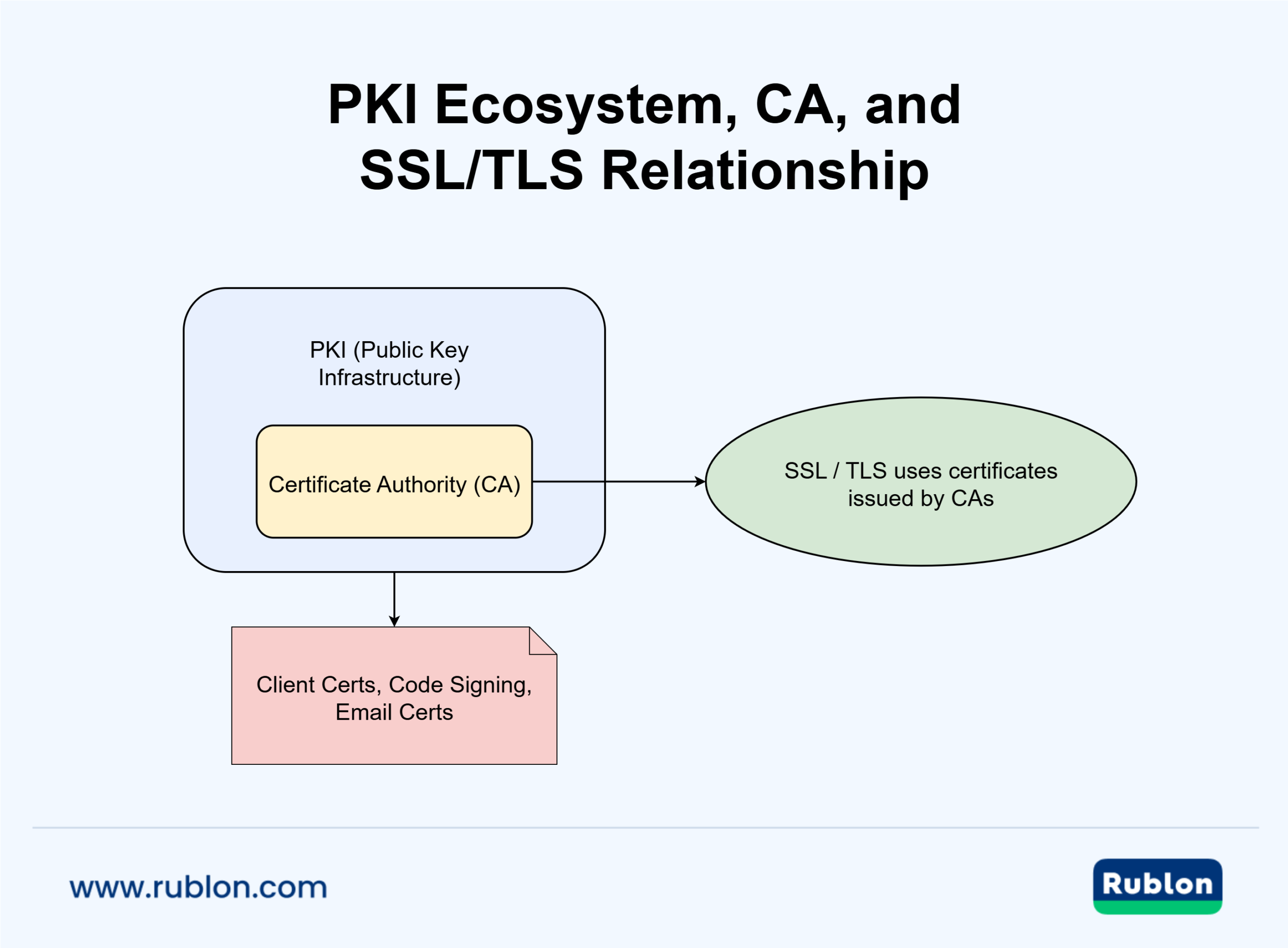
SSL (Secure Sockets Layer) and TLS (its successor, Transport Layer Security) are cryptographic protocols for securing communication channels over networks. SSL/TLS relies on PKI to handle server (and optionally client) authentication: the server presents a certificate, the client validates the chain and revocation, then they negotiate encryption keys. In essence:
| Term | Role | Scope |
| PKI | Framework for certificates, trust, revocation, lifecycle | Broad: supports multiple use cases (web, email, devices) |
| CA | The issuer/signing authority inside PKI | A component in the PKI architecture |
| SSL / TLS | Protocol for secure communication | One major consumer of PKI (for web, APIs, etc.) |
Because SSL is older, many still say “SSL certificate,” but nowadays it’s almost always a TLS certificate issued under PKI. TLS wouldn’t function without a PKI to authenticate endpoints.
Why the Confusion Happens & Why It Matters
- Shortcut naming: Many non-technical users or even some marketers say “SSL” while meaning PKI or certificate services.
- Overlapping vocabulary: People might refer to “issuing certificates” and mean CA, or “PKI certificate” and mean “TLS certificate.”
- Conflated responsibility: One might think PKI = CA (i.e., PKI is just the signing entity), which obscures the importance of validation, revocation, and lifecycle management.
- Misapplied security tradeoffs: If someone treats SSL/TLS as a standalone solution and ignores PKI operations (revocation, certificate rotation, policy), they risk critical weaknesses in the trust chain.
Example: TLS Certificate Issuance Workflow
To see how they interact in practice:
- The CA (part of PKI) signs an X.509 certificate for a web domain.
- That certificate is used in the TLS handshake by a server to prove identity.
- The client (browser or other application) validates the chain via PKI rules and rejects or accepts it.
- If SSL/TLS fails or the certificate is invalid, the connection is dropped even if the PKI infrastructure “works.”
Here, PKI provides the trust fabric, and CA issues the credential; SSL/TLS is how that credential is used during communication.
PKI Architecture Models & Trust Models (Hierarchical, Bridge, Mesh, Hybrid)
Why Trust Models Matter in PKI
In PKI, trust models define how trust is established, propagated, and validated between Certificate Authorities (CAs) and relying parties. The chosen model affects scalability, path discovery complexity, security risk, and interoperability. Expert treatments (e.g., “Trust Models and Management in PKI” from RSA Labs) compare how different structures trade off between simplicity, flexibility, and performance.
Below are the major trust architectures used in real PKI deployments:
Hierarchical (Tree) Model: the Classic Structure
- Structure: One root CA at the top, issuing certificates to intermediate (subordinate) CAs, which then issue certificates to end entities.
- Trust flow: Unidirectional and straightforward: clients validate chains from the end-entity up to the root.
- Advantages:
- Simple path discovery (predictable chain length)
- Clear governance and control
- Easier constraint enforcement (e.g., name constraints, policy)
- Drawbacks/risk:
- Root CA is a single point of failure or attack
- Scaling across domains is difficult (each domain must either trust the same root or cross-certify)
- Use cases: Web PKI, internal enterprise PKI, corporate CA hierarchies
Mesh (Cross-Certification) Model
- Structure: Multiple independent CAs issue cross-certificates to each other in a peer-to-peer fashion.
- Trust flow: Clients may need to discover multiple chains across CA boundaries (mesh paths).
- Advantages:
- Good for federated systems or organizations with independent CAs
- No single root needed; more resilience
- Drawbacks/complexity:
- Path discovery is harder (multiple possible paths)
- More complex certificate extensions and constraints are needed
- Increased validation computation (especially on resource-constrained devices)
- Use cases: Federated government domains, international trust frameworks
Bridge CA Model
- Structure: A Bridge CA acts as a hub to interconnect multiple PKIs/domains. Each domain CA cross-certifies with the bridge rather than with each other.
- Trust flow: A relying party can build a path: End-entity → their CA → Bridge CA → target CA → target certificate.
- Advantages:
- Reduces the number of cross-certificates required compared to a full mesh
- Easier interoperability across domains
- Less complexity in path discovery than mesh
- Challenges:
- The Bridge CA becomes a critical part of trust (if it fails or is compromised, it affects multiple domains)
- Mapping certificate policies/constraints across domains must be carefully handled
- Real-world example: Some intergovernmental or federated CA networks use bridge architectures to connect disparate PKI domains.
Hybrid / Mixed Trust Models
- Structure: Combinations of hierarchical, mesh, and bridge elements. For example, one part of the PKI uses a hierarchical tree internally, but cross-certifies to external domains via a bridge.
- Why use a hybrid? Real systems often need flexibility: internal trust, cross-domain interoperability, and legacy system bridging.
- Advantages:
- Allows customizing trust per domain (internal vs external)
- Enables phased migration between models
- Drawbacks:
- Complexity in validation logic and trust path management
- Risk of misconfiguration or policy divergence
- Performance and scalability concerns if many cross-links are used
Many large PKI deployments adopt hybrid architectures for flexibility and growth.
Comparative Snapshot & Trade-Offs
| Model | Strengths | Weaknesses | Best Suited For |
| Hierarchical | Simple validation, governance control | Single point risk, limited cross-domain | Enterprise, Web PKI |
| Mesh | No centralized root dependency, resilience | Complex path discovery, computational cost | Federated domains, peer networks |
| Bridge | Simplified interconnection, fewer cross-certs | Bridge becomes critical, policy mapping effort | Multi-domain interoperability |
| Hybrid | Flexible, scalable, supports legacy | Complexity, tuning required, path logic overhead | Large enterprises, global systems |
Practical Considerations in Trust Model Design
- Certificate path discovery & performance: The more flexible the model, the more possible paths. Devices, especially in constrained environments, benefit from simpler trust models.
- Policy mapping and constraints: When crossing domains, policy OIDs, key usage, and name constraints should be aligned or mapped by cross-certification.
- Liability & trust assumptions: In hybrid or bridge setups, domains must agree on policies, liability, and failure modes.
- Certificate revocation architecture: Each domain must support CRL/OCSP responders reachable by relying parties across trust boundaries.
- Scalability & governance load: More complex trust topologies demand more maintenance, audits, and coordination.
- Interoperability and integration: In diverse digital ecosystems, trust models must interoperate reliably. Recent studies highlight operational complexity, liability, and scalability challenges when linking different PKI trust models.
Implementing PKI: Practical Routes (On-Prem, Cloud, Hybrid)
On-Premises PKI (Private / On-Prem)
In this model, your organization builds and manages its own private PKI infrastructure entirely within its data centers or internal networks. Common in enterprises with strict control, regulated environments, or deep integration with directory services.
Key components & considerations:
- Many organizations use Active Directory Certificate Services (AD CS) on Windows Server to issue and manage certificates internally. AD CS supports certificate templates, auto-enrollment, key archival, and integration with Group Policy.
- You must carefully plan your CA hierarchy (root CA, subordinate CAs), name conventions, certificate lifetimes, CAPolicy.inf files, and CRL/OCSP infrastructure.
- Protecting private keys is essential: typically, the root CA is offline, and all key operations use Hardware Security Modules (HSMs) or secure vaults.
- You are responsible for all lifecycle tasks: issuance, renewal, revocation, audits, scaling, high availability, backups, and incident planning.
- On-prem PKI provides complete control, low dependency on external systems, and deterministic latency for certificate issuance/validation.
Trade-offs & challenges:
- Operational burden & expertise – managing PKI manually demands skilled staff and rigorous procedures.
- Scaling limitations – handling a large volume of certificates or supporting multi-cloud services is harder.
- Initial cost & complexity – hardware, redundancy, disaster recovery, audit logging add overhead.
Microsoft’s PKI design guidance enumerates these design considerations and offers best practices for CA placement, cryptographic settings, policy enforcement, and integration.
Cloud-Native / PKI as a Service (PKIaaS)
In a cloud PKI model, the infrastructure is provisioned and managed by a third-party or platform provider. You interact with APIs or dashboards rather than running CA hardware yourself.
Advantages of cloud PKI / PKI as a Service:
- Rapid setup and scaling without hardware or infrastructure planning
- Offloading maintenance, patching, backups, and high availability to the provider
- Global reach and low issuance latency across distributed user bases
- Built-in lifecycle automation, API interfaces, and dashboard visibility
Many vendors now offer cloud PKI or managed PKI services.
Microsoft’s Cloud PKI service (via Intune) is an example: administrators can create issuing CAs, control certificate lifecycle, and integrate with device management.
Considerations & trade-offs:
- Trust chaining & “Bring Your Own CA” – many providers allow you to anchor to your existing root, so the certificates issued by the cloud CA chain back to your internal trust anchor.
- Data sovereignty & compliance – ensure certificate data, key management, and logs meet regulatory or internal policy requirements.
- Vendor lock-in & API compatibility – migrating between PKIaaS providers can have friction.
- Auditability & control visibility – ensure the provider offers transparent audit logs, role-based access controls (RBAC), and security attestations.
Microsoft Cloud PKI enables you to host root and issuing Certificate Authorities (CAs) in the cloud or anchor to an existing root. It streamlines certificate lifecycle management by handling CRL publication, AIA endpoint configuration, reporting, and certificate enrollment via SCEP.
Hybrid PKI: Best of Both Worlds
Hybrid PKI blends on-prem and cloud models, enabling internal systems and cloud workloads to share a common trust structure while leveraging cloud scale where needed.
Typical hybrid patterns:
- Internal root CA, cloud issuing CA – keep your offline root in your data center, and deploy issuing CAs in cloud environments.
- Connector integration – cloud PKI providers may offer connectors to integrate with on-prem AD, letting existing CSRs flow from on-prem systems to cloud-based issuing CAs. AWS Private CA with Connector for AD is one example.
- Bridging existing PKIs to cloud form – unify disparate PKIs or migrate gradually to a managed PKI backbone while maintaining legacy systems. Some PKI toolkits support multi-tenant or hybrid architectures.
- Dual issuance across domains – issue certificates from both cloud and on-prem CAs for different workload domains while maintaining chained trust.
Advantages:
- You retain control over the root while offloading scale & management to the cloud.
Flexibility to support both internal and cloud workloads seamlessly.
Easier incremental migration from legacy to cloud PKI.
Challenges:
- Complexity in syncing revocation and certificate lifecycle across domains.
- Ensuring certificate chain consistency and trust alignment.
- Monitoring, logging, and security posture management across disparate systems.
- Increased operational overhead of hybrid systems. Solutions like PKI monitoring and posture tools help here.
Choosing the Right Route for Your Organization
When selecting an implementation route, evaluate:
- Scale & certificate volume – if you expect tens of thousands or millions of certificates (IoT, microservices), cloud or hybrid is almost mandatory.
- Operational maturity & staffing – if you lack PKI experts, managed PKI solutions reduce risk and burden.
- Security, compliance, and key custody requirements – some environments require full custody of CA root keys.
- Existing infrastructure & integration needs – integration with Active Directory, existing PKI, device management systems, or certificate protocols (SCEP / EST) matters.
- Future growth & migration flexibility – a hybrid or cloud model allows you to adapt as infrastructure evolves.
As PKI landscapes evolve with shorter certificate lifecycles, certificate sprawl, cloud workloads, and PQC readiness, many organizations adopt hybrid or cloud PKI as a manageable, scalable path forward.
Operations, Governance & Risk: Running PKI at Scale
Governance, Policies & Documentation
A PKI is more than technical infrastructure; it requires proper governance. Policies, rules, and clear responsibilities form the backbone of reliable operations.
- Certificate Policy (CP) / Certification Practice Statement (CPS): These documents define how certificates should be issued, renewed, revoked, and used. The CP sets broad policy, while the CPS describes how the CA implements those policies. The PKI Consortium emphasizes that well-defined policies and documentation help maintain trust over time.
- Roles & Separation of Duties: Key roles, such as Root CA operator, incident responder, certificate manager, should be assigned to distinct individuals or teams to prevent abuse.
- Change Management & Review Cycles: Policies must evolve. Reviews should be periodic and aligned with compliance and security changes.
- Transparency & Disclosure: Publish relevant portions of your CP/CPS or a disclosure statement so relying parties know what to expect (e.g., revocation methods, operational constraints).
Governance ensures that public key infrastructure services remain trustworthy and auditable.
Certificate Lifecycle & Day-One Operations
Running PKI at scale demands managing every stage of a certificate’s life and avoiding outages.
- Discovery & Inventory: Maintain a current catalog of all certificates in the environment (issued, expiring soon, revoked). Many outages stem from untracked certificates.
- Automatic Renewal & Rotation: Automate issuance and renewal (e.g., via ACME) to prevent expiration outages.
- Revocation & Expiry Handling: Implement robust revocation procedures (CRL/OCSP) and mechanisms to retire or replace certificates before expiry.
- Recovery & Backup: Back up CA metadata, keys (if allowed), CRLs, logs, and certificate databases in a secure, auditable, and versioned manner.
- Auditing & Logging: Capture all certificate issuance, renewal, revocation, and administrative actions. Use immutable logs, tamper detection, and periodic audit reviews.
- Monitoring & Alerts: Monitor for failed issuance, approaching expirations, replica sync failures, or CA health degradation.
Effective certificate lifecycle management is critical to preventing service disruptions and trust failures.
Key Management & Private Key Protection
The security of private keys underpins the entire infrastructure.
- Hardware Security Modules (HSMs): Use certified HSMs to generate and store CA private keys. Do not expose private keys in plaintext outside the secure boundary.
- Multi-Factor Authentication (MFA): Secure access to CA consoles, certificate issuance portals, and HSMs with Rublon MFA.
- Key Rotation & Graceful Transition: Plan key rollovers (e.g., root or intermediate CA) carefully to maintain chain continuity and avoid trust breakage.
- Key Archival / Escrow (if needed): Some environments require archival of keys to decrypt past data or recover identities, but this must be controlled with strong access policies.
- Compromise Response Plans: Define and rehearse how to respond to key compromise (revoking affected CAs, reissuing certificates, updating trust stores).
- Access Controls & Multi-Party Authorization: Ensure that key operations (e.g., signing root CRLs) require multi-person authorization, audit trails, and secure physical controls.
NIST SP 800-57 provides best practices for cryptographic key management, which should inform your PKI operations.
Risk Management & Threats to PKI
Understanding and mitigating risks is essential for a resilient PKI.
- Common threats: key compromise, rogue issuance, expired certificates, revocation infrastructure failures, insider abuse, misconfigurations, replay attacks, and supply-chain risks.
- Risk Assessment Frameworks: It’s useful to adopt industry risk frameworks (e.g., ISO 31000) to model how uncertainties affect PKI and guide mitigation efforts.
- Mitigations:
- Limit CA exposure (e.g., keep root CA offline)
- Enforce certificate issuance constraints (e.g., name constraints, policy OIDs)
- Harden revocation infrastructure (redundant OCSP, CRL availability)
- Use certificate transparency, audit logs, and certificate monitoring to detect misissuance or anomalies
- Operational Risks: certificate expiration surprises, propagation delays, validation failures, sync gaps across clusters, and rolling upgrades of CA software.
Scaling Governance & Distributed Use
As PKI grows, you may need to decentralize operational tasks while retaining central policy control.
- Central Governance + Distributed Use: Modern PKI architecture often provides a centralized governance layer even while allowing teams to request their own certificates under controlled policy regimes.
- Self-Service Portals & Role Delegation: Provide certificate request APIs or portals that enforce policy boundaries but reduce manual bottlenecks.
- Multi-Tenant & Departmental Partitioning: Create distinct issuance groups or name spaces with tailored policies for different business units or geographies.
- Automated Policy Enforcement: Use certificate lifecycle management platforms to enforce CP/CPS constraints across distributed issuance.
Modern PKI for Developers & Platforms
As infrastructures evolve toward microservices, serverless, multi-cloud, and zero-trust architectures, PKI must adapt. The “classic” model of long-lived certificates bound to domains is no longer enough. Modern PKI for developers and platforms emphasizes automation, short-lived identity, workload identity (non-human), and integration with orchestration systems.
Workload Identity: Beyond User Certificates
Traditional PKI often focuses on users or servers. Today, the identity layer must work for services, containers, functions, and edge devices. Platforms demand that machines carry strong, verifiable identities without manual key management.
SPIFFE (Secure Production Identity Framework for Everyone) is emerging as a standard solution here. Under SPIFFE:
- Each workload is given an SPIFFE ID (a URI representing its logical identity).
- That SPIFFE ID is encoded in an X.509 SVID (SPIFFE Verifiable Identity Document), a certificate tailored for service identity.
- Developers don’t issue certificates manually; the runtime (SPIRE or equivalent) automates identity issuance, rotation, and verification.
- Workloads verify identity via mutual TLS or token checks without needing static credentials.
This model is well-suited for Kubernetes, service meshes, and distributed systems.
Automatic Issuance, Rotation & Short-Lived Certificates
Because workloads may spin up or down quickly, manual certificate management is untenable. Modern PKI emphasizes:
- Dynamic issuance & rotation: Certificates should be automatically issued and replaced frequently (e.g., hourly, daily) to reduce reliance on revocation.
- Short-lived validity: Shorter lifetimes mean stale or compromised certificates pose less risk; revocation checks become less critical.
- Platform integration: Identity systems integrate directly into orchestration (Kubernetes, containers, edge).
- Interfaces & APIs: Workload APIs (like SPIFFE Workload API) allow code or sidecars to fetch valid identities without exposing private key details.
By combining automatic rotation and minimal lifetime, PKI becomes more resilient and easier to operate in high-churn environments.
Examples in Practice: Service Mesh & Envoy + SPIRE
One widely adopted pattern is using Envoy sidecars that consume X.509 SVIDs on behalf of applications. The mesh proxy handles mTLS, leaving application logic simpler. In Kubernetes, for example:
- SPIRE issues X.509 SVIDs to part of the system.
- Envoy retrieves these certificates (via SDS, secret discovery) and uses them for in-cluster mutual TLS.
- Services communicate via mTLS with certificate-based identity, not IP or network rules.
This architecture decouples identity from host networking and supports zero-trust communication across services.
Hybrid Identity: Bridging to Web PKI & Legacy
Modern PKI platforms often need to interoperate with classic domain-based certificate infrastructures. Hybrid identity models include:
- Bridging SPIFFE identities to domain certificates (e.g., issuing ephemeral certificates for external API endpoints).
- Federated trust domains, where identities from separate trust domains (e.g., different organizations or clouds) can interoperate securely.
- Dual-mode certificates (hybrid PQC / classic) to support migration strategies for post-quantum cryptography. (Researchers are already building tooling for hybrid certificate support in X.509 workflows).
Hybrid strategies let newer systems adopt workload-first identity while preserving compatibility with existing clients and protocols.
Tooling, SDKs & Developer Experience
To make PKI adoption practical for developers, modern platforms ship:
- Language SDKs (Go, Java, Python) for interacting with workload APIs and handling SVIDs / rotation.
- Sidecars/agents that abstract certificate management away from application code.
- Zero-configuration integrations (e.g., in Kubernetes) so that containers can get their certificate automatically without manual setup.
- Observability & debugging tools to surface certificate life cycles, identity validation, and failure modes.
These tools reduce friction and shift PKI from being a security engineering burden to a seamless part of platform infrastructure.
Risks & Considerations in Modern PKI
- Library correctness & validation quirks: Inconsistencies in parsing SANs, key usage, and path validation across libraries may lead to subtle interoperability or security bugs.
- Agent attestation / bootstrapping: Trust must be anchored securely (e.g., node attestation) so that only legitimate workloads can request identity.
- Certificate exhaustion or churn overhead: Even with short lifetimes, systems must manage state and cache identity data efficiently.
- Migration to post-quantum algorithms: PKI must evolve to accommodate new cryptographic primitives while supporting legacy interoperability.
- Trust domain partitioning & federation complexity: Defining and managing trust between multiple domains or clouds can introduce complexity in policy and path validation.
Public vs Private PKI: When to Use Which
What Do “Public PKI” and “Private PKI” Mean?
- Public PKI refers to certificates issued by publicly trusted Certificate Authorities (CAs). These certificates are automatically recognized by browsers, operating systems, and client devices because the root CA is built into their trust stores.
- Private PKI (or internal PKI) is run within an organization or restricted domain. The CA root and intermediates are under your control; certificates are trusted only within your specified boundaries (networks, apps, devices).
Though their certificate formats (X.509) and cryptographic operations are identical, the trust boundary, governance, and usage context differentiate them.
Key Differences & Trade-offs
| Characteristic | Public PKI | Private PKI |
| Trust Scope | Global trust via built-in root stores | Trusted within a defined domain or network |
| Ease of Use | Users get trust automatically (no manual install) | You must distribute trust anchors (root CA) to endpoints |
| Control | Limited control over issuance policies, revocation infrastructure, and root key lifecycle | Full control over policies, key management, issuance, and revocation |
| Cost Model | Typically, per-certificate fees or subscription fees | Mostly infrastructure, operational, and personnel costs |
| Use Cases | Public websites (HTTPS), email encryption with a broad audience, public APIs | Internal services (Intranet, APIs, device identity, mTLS, VPN, Wi-Fi) |
| Regulatory / Compliance | Must meet browser/CA/Browser Forum standards, audits, and public disclosure | Can tailor policies; less external oversight, but still internal audits necessary |
| Revocation & Transparency | Must publish CRLs/OCSP, often must follow CT logs/certificate transparency | You control revocation infrastructure; may not need CT or public logging |
| Migration Flexibility | Fixed trust anchors, harder to migrate across public roots | Easier to rebootstrap trust within your ecosystem when needed |
Because of these differences, public certificates are suited for services that external users or systems must trust seamlessly; private PKI is optimal when trust can be constrained within an organization or ecosystem.
When to Choose Public PKI
- Your service is internet-facing (websites, APIs) and must be trusted by end users without requiring manual root installation.
- You want to offload CA infrastructure, compliance, audits, and revocation logistics to a third party.
- You require public auditability or must comply with public PKI norms (for instance, browser requirements).
- Example: You host an e-commerce platform or public SaaS portal where global user trust matters.
Public CAs (or public PKI providers) issue TLS / SSL certificates that are widely recognized by default. They also adhere to standards from the CA/Browser Forum, audits, and root program requirements.
When to Choose Private PKI
- The systems you’re securing are limited in scope (internal APIs, IoT fleets, corporate networks, VPN access).
- You need tight control over policies, lifecycles, key protection, and compliance.
- You want to avoid recurring certificate costs or central CA fees.
- You have the capacity to operate your own certificate infrastructure (issuance, auditing, revocation).
- Example: You run mTLS between microservices within a cluster; you manage systems intimately and don’t need public trust.
Many enterprises already deploy private PKI for internal use (device authentication, Wi-Fi, smart card logon, internal certificate services). Private PKI gives you the freedom to define your own trust domain, certificate policies, validity periods, and revocation behavior.
Hybrid / Mixed Approaches & Trust Bridging
Often, the best answer is a hybrid PKI approach:
- Use a public PKI to issue certificates for client-facing domains or public services
- Use a private PKI for internal services, devices, mTLS, and user identity
- Cross-certificate or bridge trust where needed, so internal systems can communicate with public or external systems under controlled conditions
- Some private or managed PKI platforms allow anchoring to your own root while integrating public PKI issuance, giving you control + reach advantages
Because organizations sometimes evolve services from internal to external, a hybrid model offers flexibility without full lock-in on one trust approach.
Risks & Considerations for Each
- Public PKI risks: reliance on external CA availability, possible revocation delays, audit/assurance dependencies, and less control over root rollover.
- Private PKI risks: you carry the full operational burden, you must distribute root trust safely, and misconfigurations can cause critical outages.
- Hybrid complexity: mismatched policy scopes, trust mismatch, revocation synchronization, cross-certification errors, and key sprawl.
Summary: Choosing the Right Side
- Use public PKI when your service must be broadly trusted across the Internet without friction.
- Use private PKI when your domain of trust is internal, controlled, and you need full policy and key lifecycle control.
- Combine both in a hybrid strategy when you want selective public exposure while maintaining internal autonomy.
The distinction between public vs private PKI is not about which is stronger, but about the trust boundary, governance requirements, operational model, and how broadly you must establish trust.
PKI Tokens & Smart Cards (PIV, USB Tokens, “PKI Device”)
When organizations require strong authentication and hardware-based control over private keys, PKI tokens and smart cards are a go-to choice. These devices (sometimes referred to as “PKI devices”) store private keys in tamper-resistant hardware, enforce PIN or multi-factor authentication (MFA), and only allow cryptographic operations (such as signing and decryption) without exposing the key itself.
What Is a PKI Token or Smart Card?
A PKI token / smart card is a physical device (often credit-card-sized or USB form factor) that contains a secure microprocessor and memory used to store a certificate and private key. The private key never leaves the device; instead, operations (e.g., signing or decryption) are done internally. The user must typically unlock the device (e.g., via PIN or biometric) before use.
These hardware devices are used in PKI-based authentication, digital signatures, secure login, code signing, and device identity scenarios.
Examples include:
- PIV (Personal Identity Verification) smart cards, defined under FIPS 201 standards, are used by U.S. government agencies for strong multi-factor authentication via certificates stored on the card.
- USB tokens or smart cards compatible with PIV (e.g., YubiKey acting as a PIV interface), which provide similar certificate functionality in modern form factors.
- CAC cards (Common Access Cards) are used in U.S. DoD contexts. These are smart cards storing PKI certificates and keys that operate on the same principles.
These devices enhance security because even if malware touches the host system, the private key remains shielded inside the hardware.
PIV / FIPS 201 & Derived Credentials
The PIV standard (FIPS 201) mandates smart card implementations for identity credentials. It requires that smart cards hold up to several certificate slots (PIV Authentication, Digital Signature, Key Management, etc.) and support a secure interface. NIST SP 800-157 outlines how derived PIV credentials (e.g., for mobile or remote devices) still align with PKI standards while bridging to devices without card readers.
Derived PIV credentials act as certificate-based credentials derived from a master PIV card, enabling mobile devices to operate in environments lacking physical card support and yet maintain strict trust properties.
How PKI Tokens / Smart Cards Operate under the Hood
- PIN/authentication gating: The user must present a PIN or biometric to unlock use of the private key.
- Internal cryptographic operations: The token executes signing or decryption operations internally (e.g., RSA, ECC), never exposing the private key.
- Standard interfaces: These devices conform to standards like PKCS#11, PKCS#15, or CCID / smart card minidrivers, enabling broad interoperability with OS platforms and software security stacks.
- Certificate slots & capabilities: Many tokens support multiple certificate slots (e.g., authentication, signing, encryption) and extensions defined by PIV or X.509.
- Tamper resistance & security layers: Many tokens implement anti-tamper, epoxy covers, sensors, or zeroization on tamper detection.
Because these tokens isolate key operations, they help prevent key extraction by malware or OS compromise.
Use Cases & Benefits of PKI Tokens
- Smart card logon/user authentication: The token can be required for system login, replacing or supplementing passwords.
- Digital signing/email encryption: Users sign documents or emails directly via the token’s private key.
- VPN / network access / Wi-Fi 802.1X: The device presents certificate-based identities when connecting to secure networks.
- Code signing/developer tokens: Development environments can use hardware keys for signing builds, ensuring key material never resides on developer machines.
Compared to software-stored private keys, hardware tokens reduce the risk of key leakage and provide a stronger guarantee that the user is physically present (possession + PIN).
Real-World Examples & Industry Devices
- YubiKey as a PIV smart card: YubiKey devices support the PIV interface, letting them act as smart cards for certificate authentication, signing, and decryption operations.
- PIVKey tokens / smart cards: These are compatible with PIV standards and integrate with Windows certificate enrollment, enabling certificate storage and secure operations across platforms.
- CAC / PIV cards in the U.S. government: Used for official access and services, these cards integrate with PKI and physical badge capabilities.
These devices are battle-tested in high-security government and enterprise environments.
Challenges & Considerations with PKI Tokens
- User experience & provisioning overhead: Managing, distributing, and issuing tokens can introduce logistical complexity.
- Loss or theft: Tokens must be revocable; policies often require rapid deactivation and re-issuance.
- Compatibilities: Systems must support token interfaces (drivers, middleware, smart card stacks).
- Cost: Hardware, management software, and lifecycle support can add up.
- Scalability: In environments with many devices or users, provisioning, enrollment, and backup strategies must scale.
Despite these challenges, tokens and smart cards remain a high-assurance component in the PKI ecosystem, especially where control over private keys and user presence proof are critical.
Post-Quantum & Crypto-Agility: The 2026 Roadmap
While PKI remains foundational today, its future depends on how well it adapts to emerging threats, especially quantum computing. Here’s what organizations need to know heading into 2026 and beyond.
As quantum computing advances, classical public key systems (RSA, ECC) face existential risk because quantum algorithms (e.g., Shor’s) can break them. To maintain trust in PKI, organizations must adopt crypto‑agility by using architectures that can swap cryptographic algorithms without catastrophic disruption.
Why Crypto-Agility Matters for PKI
- Quantum computers, once sufficiently capable, will render today’s PKI vulnerable.
- Transitions in cryptographic standards take years or decades; planning early is crucial.
- Crypto-agility enables your infrastructure to adapt to new cryptographic algorithms (including PQC) without halting services.
- The NIST CSWP “Considerations for Achieving Crypto Agility” (draft) explores strategies and operational constraints to support algorithm migration.
- The NIST PQC project and its roadmap emphasize that you must prepare now, even before quantum is reality, to avoid ‘harvest‑now, decrypt‑later’ attacks.
Milestones & Standards in 2026
- In August 2024, NIST published the first three PQC FIPS standards:
• FIPS 203 (ML-KEM, formerly CRYSTALS-Kyber) for key encapsulation
• FIPS 204 (ML-DSA, formerly CRYSTALS-Dilithium) for digital signatures
• FIPS 205 (SLH-DSA, a hash-based signature, backup) - In March 2025, NIST announced plans to integrate HQC as a backup KEM algorithm, expanding the PQC select set.
- NIST’s “Migration to PQC” documents and presentations outline testing, interoperability, and performance constraints organizations must consider.
- The draft NIST white paper on crypto agility (CSWP 39) is now in a second public draft (as of July 2025), soliciting feedback on crypto-agility models, strategies, and maturity planning.
- In 2026, ecosystem vendors (TLS, SSH, VPN, HSM, browsers, and cryptographic libraries) accelerate the deployment of hybrid PQC mechanisms, enabling production‑grade interoperability testing of ML‑KEM and ML‑DSA without risking compatibility loss.
Key Steps in Your PQC / Crypto-Agility Roadmap
- Inventory & Classification: Catalogue every layer of your PKI usage: certificates, keys, algorithm types, dependencies in software/hardware, protocols in use.
- Risk Assessment & Prioritization: Estimate which assets are most at risk from quantum attacks. Use frameworks like NIST’s Crypto Agility Risk Assessment (CARAF) to guide decisions.
- Adopt Hybrid Algorithms: For the transitional period, use hybrid certificates combining classical algorithms (e.g., RSA/ECC) with PQC algorithms, so your system remains safe even if one fails.
- Prototype & Test Interoperability: Build non-production integration lanes to test PQC interoperability, performance, and fallback behavior across your PKI and dependent services.
- Update Protocols & Libraries: Refactor TLS, code signing, and certificate issuance flows to support modular algorithm selection. Ensure libraries, APIs, and clients support PQC-capable cryptographic stacks.
- Roll Out in Stages: Start with lower-risk assets or internal systems, then expand to public-facing services and high-value systems. Monitor outcomes and metrics.
- Retire & Deprecate Legacy Algorithms: Once confident, phase out pure RSA/ECC certificates; encourage or enforce clients to support PQC or hybrid fallback.
- Continuous Monitoring & Agility: Maintain the ability to swap algorithms again in the future; crypto‑agility must remain a first‑class concern.
Technical & Operational Challenges
- Performance overheads & key sizes: PQC algorithms tend to have larger keys, signatures, and ciphertexts, which can strain existing protocols.
- Library support gaps: Not all open-source cryptographic libraries have complete PQC support yet; some are still maturing.
- Legacy systems & backward compatibility: Systems that can’t negotiate new algorithms may require fallback solutions or dual-stack cryptography.
- Supply chain & hardware constraints: Some devices or firmware may lack support for PQC, complicating rollouts in embedded systems.
- Standards & consensus: Algorithm standards are still evolving, so avoid locking into proprietary PQC variants too early.
What You Should Do Now
- Enable crypto agility mindset: modular cryptographic layers, abstraction of algorithms, policies for algorithm updates.
- Begin tests with hybrid certificates (classical + PQC) in non-critical environments.
- Track readiness across libraries, devices, and infrastructure.
- Stay current with NIST and standards bodies’ releases and transitions.
- Build in metrics and observability around cryptographic transitions.
The path to a future-safe PKI is gradual but urgent. By planning now for 2026 and beyond, you ensure your infrastructure survives the quantum era with integrity and trust.
Frequently Asked Questions (FAQ)
What is the Public Key Infrastructure?
Public Key Infrastructure (PKI) is the system of roles, policies, hardware, software, and procedures that issues, manages, and revokes digital certificates to bind public keys to identities in a trusted way.
What is a PKI and how does it work?
A PKI issues certificates through a Certificate Authority (CA). A user, device, or server generates a key pair and submits a CSR. The CA verifies identity, issues an X.509 certificate, and publishes revocation details (CRL / OCSP). Clients validate by checking the certificate chain and revocation status before trusting the certificate.
What is an example of PKI?
An everyday example is HTTPS: a web server presents a TLS certificate, clients verify its CA chain and revocation, and then secure communication begins. Other examples include email S/MIME, code signing, and device identity in IoT networks.
Is PKI still used?
Yes. PKI remains foundational. Every HTTPS connection, email signing, code signing, and many internal system authentications (mTLS, device certificates) rely on PKI.
What do you mean by public key infrastructure?
“Public key infrastructure” refers to the full framework (not just certificates) that provides trust, issuance, lifecycle management, and revocation for public key systems.
What is a public key, with an example?
A public key is half of an asymmetric key pair used in cryptography. For example, your web server’s public key (e.g., RSA 2048 or ECC) is embedded in its certificate; clients use it to encrypt data or verify signatures.
What are the three primary components of public key infrastructure?
Three widely recognized components are Certificate Authority (CA), which issues and signs certificates, Registration Authority (RA), which validates identity before issuance, and certificate repository/revocation service (e.g., CRL or OCSP), which distributes revocation status.
How many types of PKI are there?
You can categorize PKI by trust model (hierarchical, mesh, bridge, hybrid) or by deployment model (public vs private vs hybrid). Each type has different trade-offs in trust distribution, path complexity, and governance.
What are the four pillars of PKI?
While frameworks differ, four core pillars often cited are: authentication, confidentiality/encryption, integrity / digital signatures, and non-repudiation. All are enabled by binding identity to public keys.
What is an example of a PKI certificate?
A typical example is the TLS certificate for www.example.com: it includes the public key, the domain (SAN), issuer data, validity dates, and extensions defining its use (e.g., key usage, SAN, AIA, CRL DP).
Why do we need a PKI?
We need PKI to scale trust in digital systems. PKI solves how to establish identity, encrypt data, verify signatures, and manage expired or compromised credentials across networks without manual trust configuration for every party.
What is the future of PKI?
The next evolution of PKI will emphasize automation, shorter certificate lifespans, integration with workload identity systems (e.g., service mesh), and migration to post-quantum cryptography to resist quantum attacks.
What type of certificate is most often used in modern PKI?
The most common usage is TLS / HTTPS / SSL certificates (X.509) for web servers, as the Web PKI is one of the highest volume consumers of certificates.
Do websites use PKI?
Yes. Websites use PKI to secure HTTPS connections. The server presents a certificate, which the client verifies via PKI mechanisms before establishing an encrypted session.
What are the disadvantages of PKI?
Some downsides include operational complexity, key compromise risk, certificate expiration mishaps, revocation latency, misconfigurations, and the challenge of scaling policies across distributed systems.
How big is the PKI market?
According to Mordor Intelligence, the global PKI market is valued in billions of USD. For example, one forecast estimates USD 7.42 billion in 2025, scaling to ~USD 19.49 billion by 2030. Another analysis sets the 2024 base at USD 6.37 billion, with a projected rise to USD 19.65 billion by 2030.