
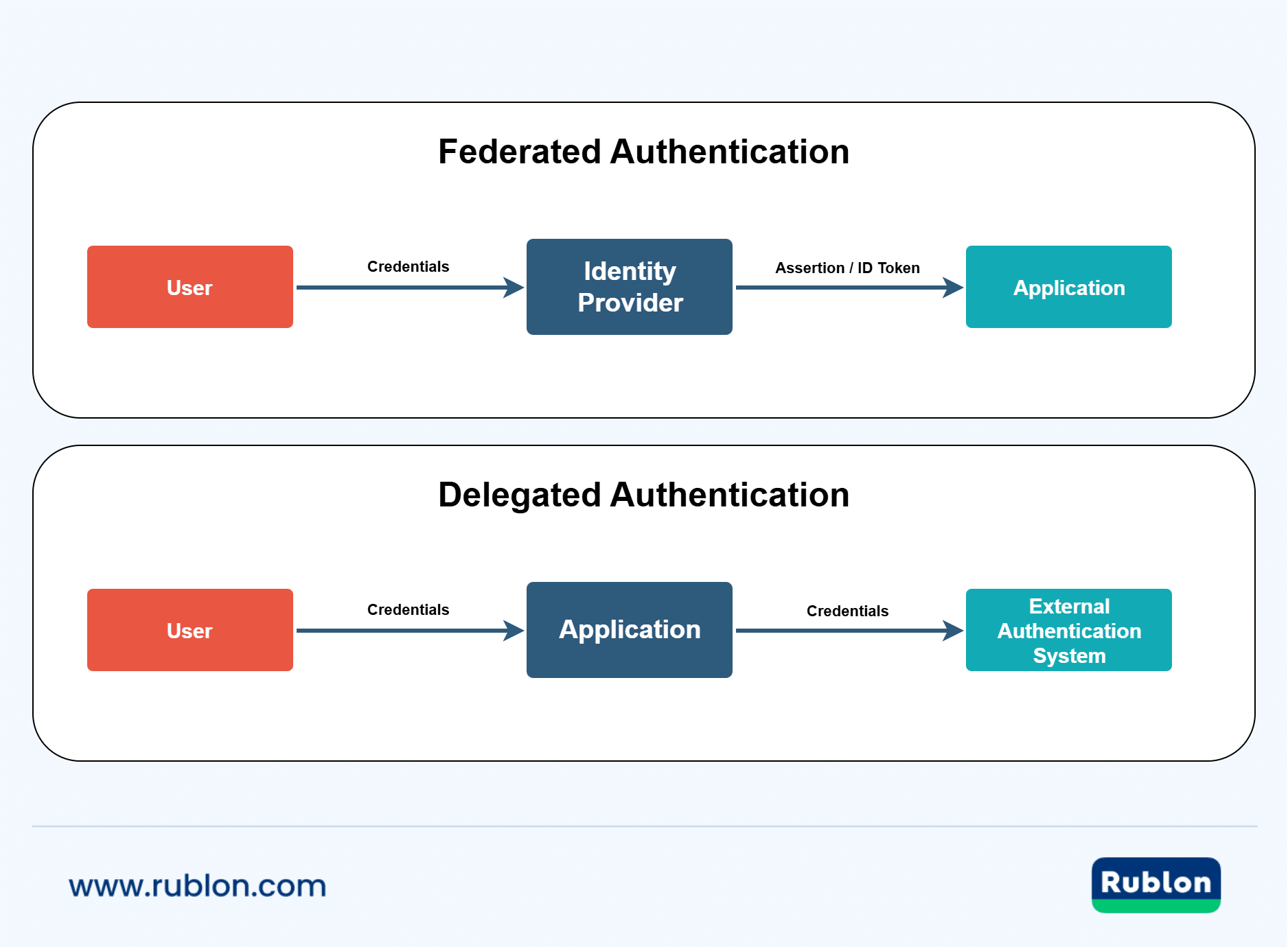
Delegated authentication and federated authentication are related concepts, and the terminology is not completely standardized. Federated identity itself delegates authentication to an external Identity Provider (IdP). In this article, however, delegated authentication refers to the narrower model in which an application handles the user’s credentials and asks an external authentication system to validate them. Federated authentication refers to a model in which the user authenticates with an IdP and the application relies on a trusted assertion or identity token issued as a result of that authentication.
Phishing-Resistant FIDO MFA
Interested? Try our phishing-resistant multi-factor authentication for 30 days for free and see how simple it is.
What is Delegated Authentication?
Delegated authentication is a model in which an application accepts a user’s credentials and delegates their validation to an external authentication system, such as a directory or authentication service. The user still signs in to the application, and the application handles the credentials, but it does not validate them against its own local credential store. Instead, it sends them to the external system and uses the returned authentication result.
This model is common in legacy and enterprise integrations that rely on centralized credential validation, but it requires the application to protect user credentials while handling and transmitting them.
What is Federated Authentication?
Federated authentication relies on a trust relationship between a Service Provider or Relying Party (SP/RP) and an Identity Provider (IdP). The user authenticates with the IdP, which issues an assertion or identity token representing the authentication event and the user. The SP/RP validates that artifact and uses it to establish an authenticated session.
The assertion or token may also contain additional identity claims, such as an email address, group membership, or role, but rich identity attributes are not a defining requirement of federation. Common federation protocols include SAML 2.0, OpenID Connect (OIDC), and WS-Federation. Federation commonly enables Single Sign-On (SSO) across applications and identity domains and reduces the exposure of users’ primary credentials to individual applications.
Federated Authentication vs. Delegated Authentication: What’s the Difference?
Using the narrower definition of delegated authentication described above, the main difference is how the application obtains proof that the user has been authenticated.
With delegated authentication, the application handles the user’s credentials and asks an external authentication system to validate them. With federated authentication, the application normally does not handle the user’s primary credentials. Instead, it relies on a trusted assertion or identity token issued after authentication at the IdP.
The distinction therefore concerns credential handling and how the authentication result crosses the trust boundary, not the number of identity claims returned or whether the IdP communicates directly with the application.
Delegated vs. Federated Authentication: Key Differences Table
| Feature | Delegated Authentication | Federated Authentication |
|---|---|---|
| How Authentication Happens | The application receives the user’s credentials and sends them to an external authentication system for validation | The user authenticates with an IdP, and the application relies on a trusted assertion or identity token representing the authentication result |
| Primary Credentials | Handled by the application or SP and passed to the external authentication system | Normally handled only by the IdP and not exposed to the application or RP |
| Authentication Result / Identity Data | Often a validation result; additional information depends on the implementation | An assertion or identity token identifies the authenticated subject and may contain additional claims or attributes |
| Common Mechanisms | LDAP, RADIUS, or proprietary credential-validation APIs and protocols | SAML 2.0, OpenID Connect (OIDC), WS-Federation |
| Single Sign-On | Users commonly authenticate separately to each application unless another SSO mechanism is present | Commonly supports SSO across multiple applications or security domains |
| Security Considerations | The application handles primary credentials, increasing the number of systems that must protect them | Primary credentials are normally kept at the IdP, but assertions, tokens, trust relationships, and federation endpoints must be protected |
| Common Use Cases | Legacy and internal applications, network appliances, and systems that need to validate centrally managed credentials but cannot use federation protocols | SaaS applications, partner portals, cross-domain access, and applications that support standards-based SSO |
Free Trial of Phishing-Resistant Rublon MFA →
Advantages of Delegated Authentication over Federated Authentication
- Can integrate legacy applications and systems with an existing centralized authentication source without requiring support for federation protocols.
- Works with applications and network services that expect direct credential-based authentication.
- Allows organizations to keep credential validation centralized instead of maintaining a separate password store in every application.
- May require fewer changes when adding centralized authentication to an existing application that cannot process federation assertions or identity tokens.
Advantages of Federated Authentication over Delegated Authentication
- Reduces exposure of primary user credentials because the application or RP normally does not handle them.
- Provides standards-based trust between the application and the IdP through protocols such as SAML 2.0 and OIDC.
- Commonly enables Single Sign-On (SSO) across multiple applications and organizations.
- Can provide identity claims and attributes needed by applications while allowing the IdP to control what information is released.
- Supports centralized authentication controls at the IdP and is well suited to cross-domain and partner access scenarios.
Key Standards, Guidelines & Findings (Delegation & Federation)
- NIST SP 800‑63C “Digital Identity Guidelines: Federation and Assertions (2025)” describes federation as the process where an Identity Provider (IdP) provides authentication attributes and optionally additional subscriber attributes to multiple relying parties, via assertions. NIST SP‑800‑63C
- Microsoft’s “Federated Identity Pattern” advises delegating authentication to a trusted external IdP to simplify development, reduce credentials administration overhead, and improve user experience through claims‑based tokens. Microsoft Azure – Federated Identity Pattern
- RFC 9560 (April 2024) defines a federated authentication architecture for RDAP based on OpenID Connect: it outsources identification/authentication to a trusted IdP, enabling reuse of existing identifiers and reducing the user credential burden across many servers. RFC 9560 – Federated Authentication for RDAP
Challenges & Considerations
While both Delegated and Federated Authentication bring benefits, there are trade‑offs to bear in mind:
- Security: Delegated flows risk credential leakage; federated flows need strong token security and safeguarding of identity claims.
- Protocol & Infrastructure Complexity: Setting up federated authentication (metadata, trust, certificates) is more complex than simpler delegated or proprietary mechanisms.
- User Experience: Delegated authentication may not make it clear to users which external authentication system is validating their credentials; federated authentication may introduce additional redirects or consent flows.
- Reliability & Availability: Dependence on external IdPs or authentication systems introduces points of failure; if the IdP is unavailable, federated or delegated systems may fail or degrade.
Why This Matters Today
Modern IAM environments often combine federated authentication with delegated authorization, but these are different concepts. OAuth 2.0 is an authorization framework that allows a client to obtain limited access to protected resources, including access on behalf of a user. By itself, OAuth 2.0 does not define how an application authenticates an end user.
OpenID Connect (OIDC) adds an identity and authentication layer on top of OAuth 2.0 and can be used for federated user authentication. OAuth scopes and access tokens, by contrast, are mechanisms for controlling delegated access to resources and APIs.
Older OAuth flows in which an application collects the user’s username and password, such as the Resource Owner Password Credentials grant, should not be used in modern OAuth deployments. Current OAuth security best practices explicitly prohibit this grant because it exposes the user’s credentials to the client and is incompatible with many modern authentication mechanisms.
Delegated vs. Federated Authentication: Which Is Right for You?
- Choose federated authentication when you want standards-based SSO, cross-domain trust, or an architecture in which applications do not handle users’ primary credentials. SAML 2.0 and OIDC are common choices for these scenarios.
- Choose delegated authentication, in the narrower sense used in this article, when a legacy application, internal system, or network service must accept user credentials but can validate them against an external centralized authentication system instead of maintaining its own password store.
- For applications that need limited access to APIs or protected resources on behalf of users, use an appropriate delegated authorization mechanism such as OAuth 2.0. If the application also needs to authenticate the user through the same ecosystem, use OpenID Connect.
Conclusion
Delegated authentication and federated authentication both allow an application to rely on an external authentication system, but they do so in different ways.
In the delegated authentication model described in this article, the application handles the user’s credentials and delegates their validation to another system. In federated authentication, the user authenticates with an IdP and the application relies on a trusted assertion or identity token instead of processing the user’s primary credentials.
The choice should therefore be based primarily on credential handling, protocol support, SSO requirements, trust relationships, and compatibility with existing systems rather than on how many identity claims an application needs.